
Amazon is usually a little cheaper on identical items, but the gap is small, it flips by category, and it can disappear once shipping, membership and seller choice enter the picture. The honest answer to "which is cheaper, Amazon or Walmart?" is: it depends on the product, the day and the seller, so the winning move is to check the exact item at both stores before you pay.
Below, we pull together what the large price studies found, show where each store tends to win, explain the costs that change your final total, and give you a simple routine for comparing the same product on both sites.
TL;DR
- Across large studies, Amazon has a modest edge on identical items, and Walmart is its closest rival. The gap is single digits for most shoppers.
- Results depend on the method: one study found Walmart cheaper per basket, another found it pricier per item.
- Shipping, membership fees, marketplace sellers and sales-event timing can swing the final total more than the sticker price.
- Compare the exact model number, the seller and the total at checkout, then look at price history before you buy.
- Set an alert on the item you want and let the lower price come to you.
Table of Contents
- What the big studies say about Amazon vs Walmart prices
- Where each store tends to win
- Why the sticker price is only half the story
- How to compare the exact same product on both sites
- When you buy matters as much as where
- Perspective
- Try it on the item you are about to buy
- A simple decision guide
- FAQ
- Sources
What the big studies say about Amazon vs Walmart prices
The most cited yearly benchmark is Profitero's Price Wars study. Its 2024 U.S. edition found Amazon had an average 14% price advantage over competitors, with Walmart as its closest competitor at prices 5% higher on identical items, up from a 4% gap the year before. Kiplinger's summary of the same series notes that Amazon beat Walmart in every one of the 16 categories analyzed, though its lead was narrow in beauty and toys.
A smaller, more recent test tells a more mixed story. LendEDU compared 50 nearly identical products and found Walmart's total basket 1.73% cheaper than Amazon's, while Walmart was 5.50% more expensive per item on average. Both can be true: a few big-ticket items where Walmart is cheaper can outweigh many small items where it is not. LendEDU also warns that prices change daily and may not match what you see today.
Three practical lessons follow:
- Averages hide the item you actually want. A 5% gap on average can be 20% in your favor on one product and 10% against you on another.
- Study method matters. Basket totals, per-item averages and "who has the lowest price on this SKU" are different measurements. Treat each as a hint, not a rule.
- Old results age fast. A comparison from several years ago describes different pricing algorithms and different store strategies.
Where each store tends to win
Category is the best predictor of who is cheaper, though even that shifts over time.
| Category | Typical pattern | What to do |
|---|---|---|
| Electronics and accessories | Amazon often leads, but big sales can flip it | Compare the exact model number and check history |
| Household basics and pantry | Close race, with store brands and bulk packs deciding it | Compare price per unit, not per package |
| Sports and outdoors | Amazon led in the Profitero data cited above | Check marketplace sellers for the same item |
| Home and tools | Walmart is gaining ground | Check both before ordering |
| Beauty and toys | Amazon's lead was narrow in the Profitero data | Compare both, and include shipping |
The home-and-tools line deserves a note. An industry publication reports that, as of August 2026, PricePilot comparison data shows Walmart winning the lowest-price determination on roughly 31% of matched home and tools SKUs, up from 12% six months earlier. The analyst quoted attributes the jump to Walmart's more accurate product feed. Whatever the cause, it is a reminder that the "Amazon is always cheaper" habit is out of date in at least some aisles.
On the Amazon side, the same logic applies to electronics, kitchen gear, tools and car accessories, where prices move often. That is exactly where tracking pays off, because a price that looks fair today may have been lower last month.
Why the sticker price is only half the story
Two listings at the same price are not the same deal. Four things move your real cost.
Shipping and membership
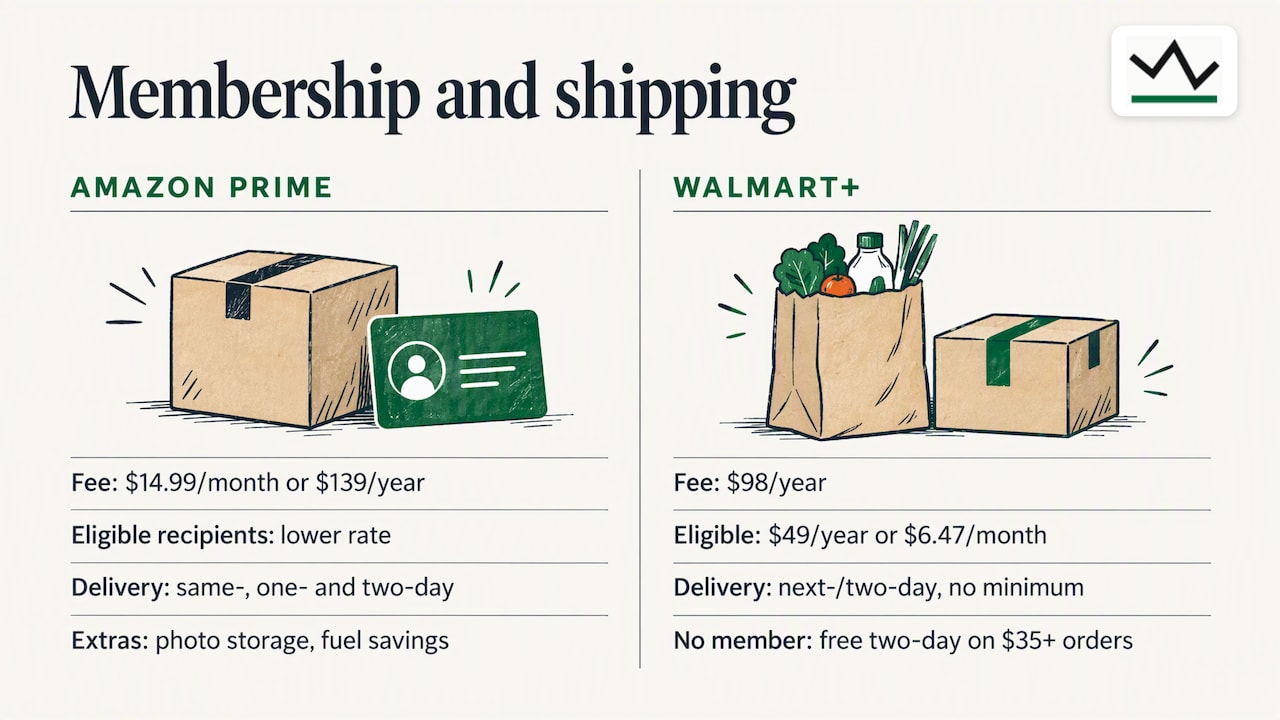
Walmart says free two-day shipping is available on millions of select Walmart.com items in orders of $35 or more without a membership. Amazon's free shipping generally comes with Prime, which is $14.99 a month or $139 a year, with a lower rate for qualifying government-assistance recipients. Walmart+ states an annual fee of $98, with $49 a year or $6.47 a month for qualifying government-assistance recipients and college students.
Membership benefits differ too. Amazon Prime lists free same-day, one-day and two-day delivery on millions of items, plus extras such as photo storage and fuel savings at participating sites. Walmart+ lists free delivery on groceries with a $35 minimum, free next-day and two-day shipping with no minimum (excluding most Marketplace items), and free pharmacy delivery. If you already pay for one membership, the other store starts with a handicap on small orders.
Who actually sells the item
Both sites run third-party marketplaces. Seller quality and return handling vary, so a professional comparison advises favoring items sold and shipped by Amazon or Walmart, or by clearly high-rated sellers. A lower price from an unknown seller is not automatically a better price: slower shipping, a harder return or a counterfeit risk eats the saving. The same principle applies when you shop for anything online, and a guide to all-in prices and guarantees on another kind of marketplace shows how fees and buyer protections change which listing is truly cheaper.
Taxes and local pricing
Sales tax may apply in some states, and the rules depend on where you live. For Walmart, there is a second wrinkle: Walmart notes that store and online merchandise and prices may differ, and store prices can vary because each store manages its own inventory and local pricing. If you plan to pick up in store, check the price for your store, not the national website.
Price matching
Do not count on one store matching the other. Walmart's policy, as summarized by a policy-tracking site, covers matching its own Walmart.com price in store and does not match Amazon. Confirm the current rules with the store before you rely on it.
How to compare the exact same product on both sites
The fastest way to get a wrong answer is to compare two products that only look alike. Use this routine:
- Match the model. Use the exact model number, and the manufacturer part number when it is listed. Specifications and included accessories should match too, since a bundle with a case or extra filter is not the same item as the bare unit.
- Check the seller. Note whether the item is sold by the retailer itself or by a marketplace seller, and who ships it.
- Add the extras. Include shipping, taxes where you can see them, and the cost of any membership you would need to buy just for this order.
- Compare per unit for consumables. A 12-pack at $18 and a 20-pack at $27 are different deals from what the totals suggest.
- Look at the history. Ask whether today's price is low for this item or just low next to an inflated "was" price.
On step 5, our guide to tracking Amazon prices over 365 days and verifying the "was" price walks through it, and if you shop at the other store as well, you can see Walmart price history the same way.
When you buy matters as much as where
Prices on both sites move constantly, and sale events can distort them. An NBC News report from July 2025 found that some Amazon items rose in price in the weeks before Prime Day, while some Walmart items rose in May or June ahead of its July sales event. The reporters' advice: check prices at least two weeks before a sale so you know how much you are really saving.
What about the "best day of the week"? The evidence is soft. A 2025 Smartproxy study, as reported by a local news station, found prices generally lower on Tuesday mornings and highest on Friday mornings. Another 2025 analysis, from Decodo, found Wednesday was the day Amazon products had a 100% rate of significant price drops of 10% or more. Those two findings do not agree, which tells you there is no reliable weekday trick. Item-level history beats any calendar rule.
Seasonal events are more predictable than weekdays. If you are timing a purchase, these pages show how past events actually played out:
- Prime Big Deal Days 2026, with how many prices really fell
- Amazon Black Friday 2026, including the likely window
- After-Christmas sales
- Prime Day, the Big Spring Sale and Fourth of July sales for the rest of the year
Each retailer announces its own event dates, so check the official pages for the current schedule.
Perspective
Here is how we see the Amazon vs Walmart question at BasketPrice. Shoppers ask "which store is cheaper?" when the better question is "is this price good for this item right now?" A store that is 5% cheaper on average can still be the more expensive choice on the one product in your cart.
That is why we publish price records built from our own readings of Amazon prices, not from the "list price" or "was" figure a merchant shows. A discount badge tells you what the seller wants you to believe. A recorded history tells you what the price actually did.
Our approach is designed for people who do not want to spend an evening comparing tabs. You can set a price-drop alert from your browser without creating an account, and our alerts include triggers such as a price drop after you have bought, while you are still inside the return window. In practice, that means a purchase does not have to be final the moment you click.
Our advice: use the studies to know where to look first, use the exact-match routine to compare, and let history and alerts decide the moment to buy.
Cleaning
Try it on the item you are about to buy
If there is a specific product in your cart, start with its history rather than a general ranking. BasketPrice records Amazon prices and shows how an item has moved over time, so you can see whether today's price is a real low. You can set up price drop alerts on our Amazon price tracker and get a browser notification when the price falls to your target, or when an item is back in stock.
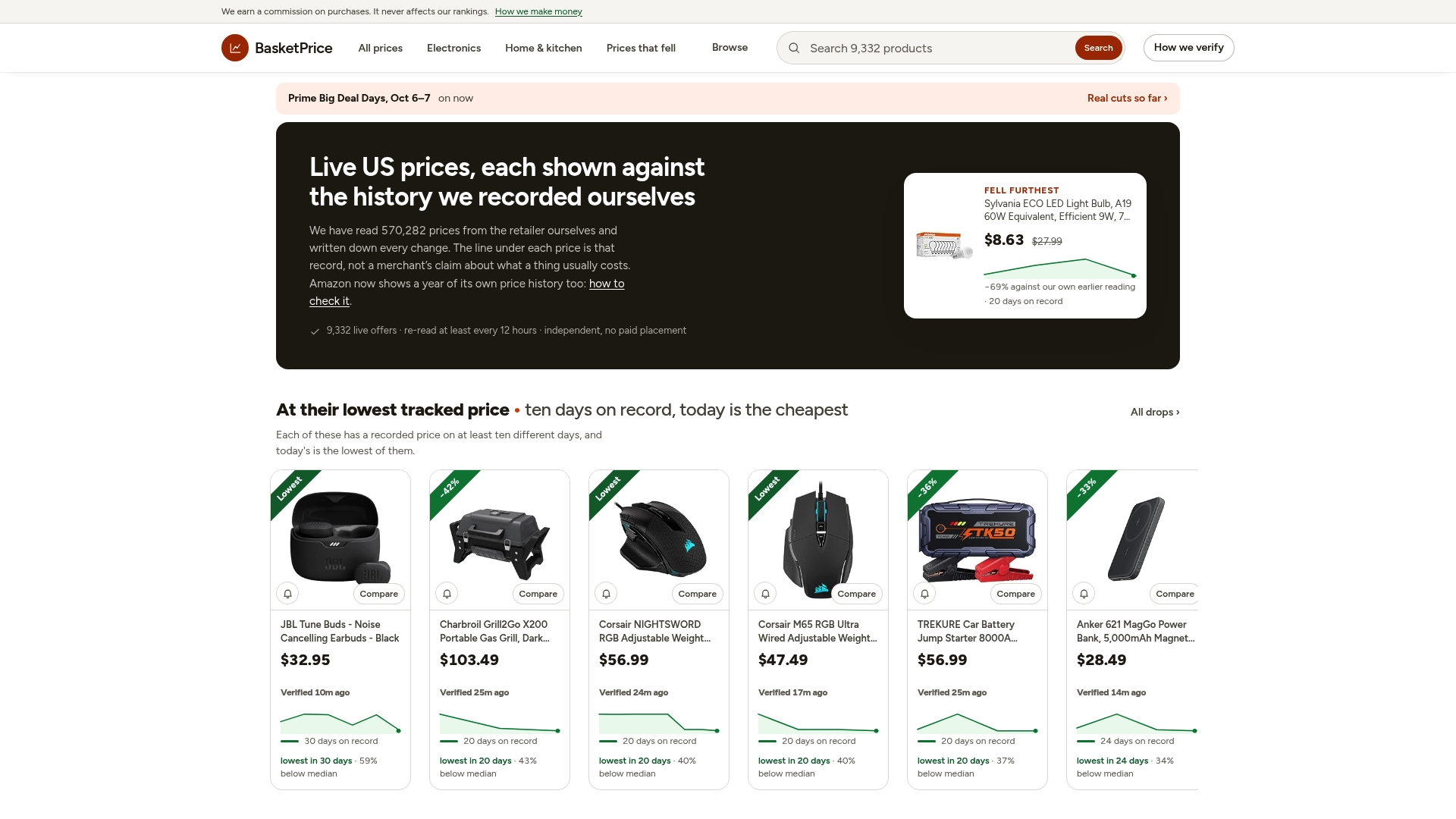
Want to browse before you track? Our discount finder lists Amazon prices that really fell against their own history, and our deals page compares thousands of current prices against their records. If you shop in a specific category, we cover car, electronics, home and sports and outdoors products, and you can open a monitors price page or a brand page to see typical price ranges.
A simple decision guide
Use these rules when you do not want to overthink it.
- Buying one expensive item (electronics, appliances, tools): compare the exact model at both stores, check seller and shipping, and look at 90 to 365 days of history. Set an alert if the price is not clearly low.
- Stocking up on household basics: compare price per unit and decide where your membership gives you free delivery. Walmart's free shipping threshold and Amazon's Prime shipping are the deciding factors on small orders.
- Buying near a major sale: record the price at least two weeks early, so you can tell a real discount from a markup that was added before the markdown.
- Buying from a marketplace seller: only if the total beats the retailer-sold price by enough to cover the added return risk.
- Already bought? Keep watching. If a lower price appears within the return window, you may be able to return and rebuy, or ask about an adjustment under the store's policy.
FAQ
Is Walmart generally cheaper than Amazon?
Not on average. Profitero's 2024 study found Walmart about 5% more expensive than Amazon on identical items. But LendEDU's smaller test found Walmart's whole basket 1.73% cheaper, so results vary with the products chosen. Check the specific item.
Which is cheaper, Amazon or Walmart, for groceries and household goods?
It is close and changes by product. Amazon led in the Profitero grocery data, while Walmart tends to do well on store brands and bulk basics. Compare price per unit and include delivery fees or the membership you already hold.
What is the cheapest day of the week to buy on Amazon?
There is no dependable day. One 2025 study pointed to Tuesday mornings as cheaper and Fridays as pricier, while another found Wednesday had the most big price drops. Price history for your specific item is a better guide than the day.
Will Walmart match Amazon's price?
According to a 2026 summary of its policy, Walmart matches only its own Walmart.com price in store, not Amazon's. Policies change, so ask the store or check Walmart's official page before counting on a match.
How can I compare Amazon and Walmart prices without opening ten tabs?
Pick the exact model, note the seller and total cost at each store, then check recorded price history for the item. A price alert saves you from rechecking by hand: set your target once and wait for the notification.
Sources
- Profitero Price Wars: 2024 (U.S. edition)
- Kiplinger: Amazon vs Walmart, who has the cheapest prices
- LendEDU: Amazon vs. Walmart vs. Target price comparison
- Affiliate Times: Walmart's affiliate feed overhaul
- Ask Walmart (FAQs)
- Amazon Prime membership fee
- Amazon Prime
- Walmart+ membership
- Amazon vs Walmart 2026: Which Is Better and Safer?
- Walmart price match policy 2026
- How to compare prices across Amazon, Walmart and Best Buy
- NBC News: Summer discounts at Amazon, Walmart and other retailers
- WXYZ: Best day and times to shop for lower prices
- San Antonio Express-News: Index shows lower prices on one weekday