

The best time to buy a camera is usually one of two moments: the holiday sales from late October through Cyber Monday, or the weeks right after the maker announces a successor to the model you want. It is rarely a single calendar day. This year the first big markdowns have already started, so if you are shopping now, you are not early.
Below you will find the months that matter, how to read a model's release cycle, what to do about used gear and lenses, and how to confirm a "deal" is real before you click buy.
TL;DR
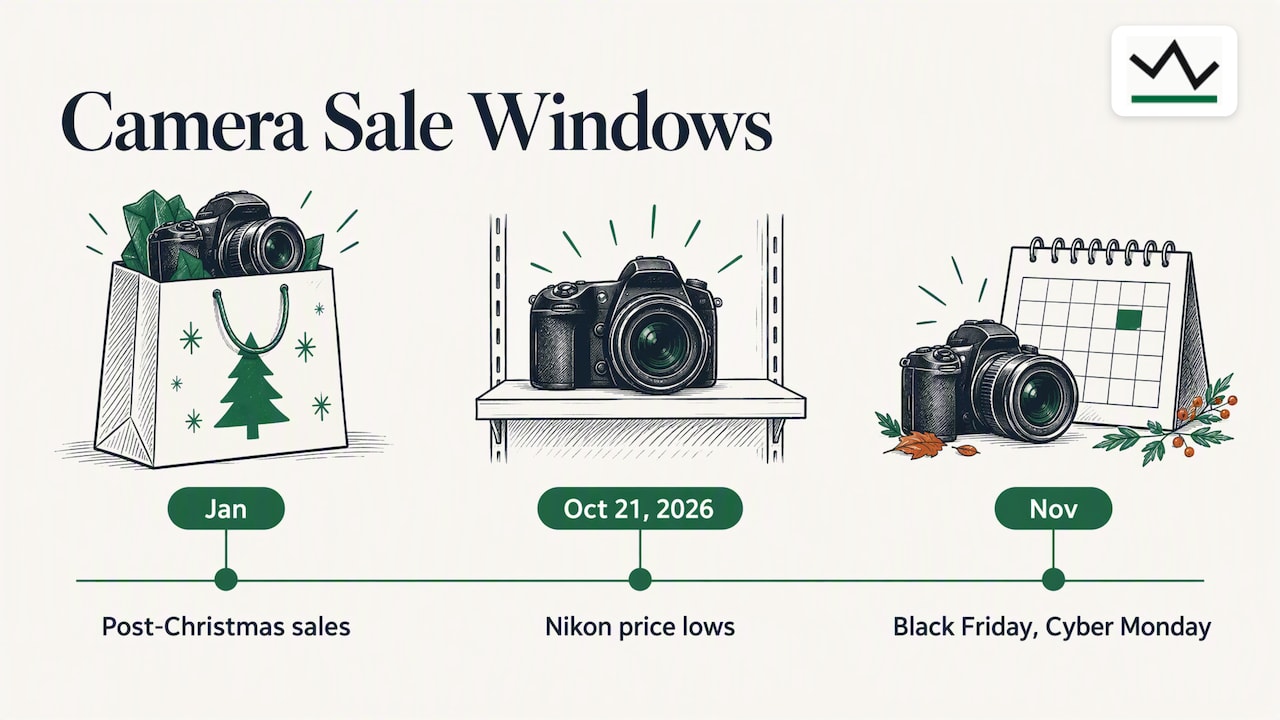
- Holiday sales (late October to Cyber Monday 2026, Nov 30) are the most reliable seasonal window, and January clearances often follow.
- The deepest cuts on a specific body usually come right after its successor is announced, so check the model's release cadence first.
- DSLRs are a shrinking segment, so do not expect deep discounts on them to be plentiful. Mirrorless is where the stock and the sales are.
- Lenses hold value better than bodies. If your budget is tight, a sale on glass may beat a sale on a new body.
- Set a price alert and compare the "sale" price against recorded history instead of trusting a crossed-out number.
Table of Contents
- The short answer by season
- Black Friday and Cyber Monday: still the big window
- Release cycles beat the calendar
- A worked example: $1,500 saved for a travel setup
- Consider lenses before a new body
- Mirrorless, DSLR and what the market is doing
- Not every camera is a mirrorless body
- Used and refurbished: a different clock
- Our perspective
- How to verify a camera deal is real
- Let an alert do the waiting
- FAQ
- Sources
The short answer by season
Camera prices follow retail rhythms, but not evenly. Here is how the year tends to break down for U.S. shoppers.
| Window | What usually happens | Good for |
|---|---|---|
| Late October to November | Early holiday deals begin, then Black Friday and Cyber Monday | Popular mirrorless bodies, kits, memory cards |
| December | Last-minute holiday promotions | Entry-level bundles |
| January | Post-holiday clearance as demand drops | Leftover stock, older models |
| Spring to summer | Manufacturer instant rebates appear sporadically, new models launch | Models about to be replaced |
| Right after a successor launch | Retailers clear the previous model | Best value on current-generation bodies |
The pattern is not a guarantee. It is a map of where discounts are most likely, and the next sections explain how to refine it for the camera you actually want.
Black Friday and Cyber Monday: still the big window
Holiday sales are the best-known reason to wait, and for good reason. Expert Photography notes that the biggest sales fall in January, just after Christmas, because shops compete once the holiday demand has passed. Between those two peaks, the November events deliver the headline discounts.
This year the calendar is already moving. On October 21, 2026, Digital Camera World reported that the Nikon Z8, Z6 III and Z5 II had dropped to their lowest recorded prices, calling it an early Black Friday. If a camera on your list is already cheaper than it has ever been, you do not need to wait for November to see whether it gets cheaper still.
Which day is better? In a Consumer Reports analysis of 2016 prices, Cyber Monday averaged $45 lower than Black Friday across the products it tracked. That is old data and it covers many categories, not only cameras, so treat it as a hint rather than a rule. For this year's dates and what Amazon is likely to run, see our pages on Amazon Black Friday 2026 and Cyber Monday versus Black Friday.
Sales no longer sit on one day
The same Consumer Reports piece describes retail pricing that reacts to inventory and shopper traffic instead of waiting for a single date. In practice, deals now stretch across weeks. That helps busy buyers: you do not have to be awake at midnight on a Friday. You need a way to notice when the price reaches the level you consider fair.
Release cycles beat the calendar
If you take one idea from this article, take this one. A holiday discount on a camera that is about to be replaced is good. A discount on that same camera the week after its replacement is announced is often better.
DPReview's guide to waiting or buying frames the decision as a balance between having the newest technology and having a camera in your hands soon. Retailers want shelf space for the new model, so the outgoing one gets marked down.
How to use that in practice:
- Find the model's launch date. Look up when your target body was released. Many manufacturers refresh a line every two to four years, though the cadence varies by brand and tier.
- Read the rumor cycle with caution. Rumors are not announcements. Do not delay a purchase you need for a trip or a job on the strength of a rumor.
- Watch the week of an announcement. The older model's price often falls soon after. Set an alert before the announcement, not after.
- Ask whether the new features matter to you. Many successors add incremental changes. If the older body already does what you shoot, the discount is the upgrade.
When not to wait
Do not wait if you have a booked trip, a paid shoot, or a camera that has stopped working. A month of use you would otherwise miss is worth something. Also skip the wait when the price is already at or near its recorded low, as with the early Nikon cuts above.
A worked example: $1,500 saved for a travel setup
One of the questions Google surfaces for this search comes from a shopper who had about $1,500 saved for a travel-vlog setup and could not decide between buying now and waiting. Here is how we would think it through.
- Trip next month? Buy within the next few weeks, but buy at a good price. Late October already brings early holiday deals, so you can set an alert on two or three candidate bodies and purchase when one hits a recorded low.
- Trip in four months or more? You can afford to wait for Cyber Monday and January. Your odds of a lower price rise, and you give a successor announcement time to arrive.
- Budget split. Do not spend the whole $1,500 on the body. Keep part for a lens, a spare battery and a card. A mid-priced body with a better lens usually serves a travel vlogger better than a pricier body with the kit zoom.
That last point is not only our opinion, as the next section shows.
Consider lenses before a new body
Camera bodies depreciate fast because sensors and processors improve every cycle. Lenses change more slowly. Imaging Resource argues that for many hobbyists a new body is not the best way to improve image quality, and that better lenses give more lasting value and creative flexibility.
What that means for timing:
- A lens discount can be the better buy even when body prices are flat.
- Lenses carry less risk of being made obsolete by a new announcement.
- If you already own a decent body, putting your money into glass during a holiday sale may beat chasing a new body.
You can check current numbers on our camera lenses page, which shows typical prices of $430 to $1,219 as of October 2026.
Mirrorless, DSLR and what the market is doing
The market has moved. According to a 2026 industry roundup, there were 6,311,054 mirrorless shipments in 2025 against 690,911 DSLR units, a 30.7% drop in DSLR shipments year over year.
Two consequences for your timing:
- DSLR bargains are not abundant. Fewer units are being made and stocked, so clearance deals are thinner and less predictable. Some older DSLR models do get cheaper over time, but the selection shrinks.
- Mirrorless is where the competition is. More models and more stock mean more frequent price cuts, especially on previous-generation bodies.
If you want to compare brands on price, our Canon price history page shows how that maker's products have moved over time. Canon reportedly held the top global position in interchangeable-lens cameras for a 23rd straight year through 2025, so its range is broad and its price history is deep.
Not every camera is a mirrorless body
The advice above is for photographers. If your "camera" is a security, doorbell or pet camera, the calendar is different: these are smart-home products that go on sale in broad retail events and often drop in price outside camera release cycles. When you are choosing one, it helps to understand pet camera features so you pay for what you will use. For home cameras, check our Blink camera sale page to see whether a deal is current.
Used and refurbished: a different clock
Used gear does not follow holiday sales as neatly. Used prices tend to follow new-model announcements: when a new body launches, owners sell the old one, and used listings rise in number. That is often a better moment to buy used than a holiday weekend. Buy from sellers that offer a return period and test the shutter count, sensor and lens mount when you receive the item.
Our perspective
We track camera prices on Amazon every day, and we publish what we record, not what a merchant says the "original" price was. That changes how we think about timing.
First, calendar advice is a starting point, not a plan. Some cameras reach their lowest price in the spring, some in January, and some on a random Tuesday. The only way to know a price is good is to compare it with what that exact item has cost over time.
Second, a list price that is crossed out tells you little. A "40% off" label can sit on a camera that was never sold at the higher price. Recorded history is harder to dress up.
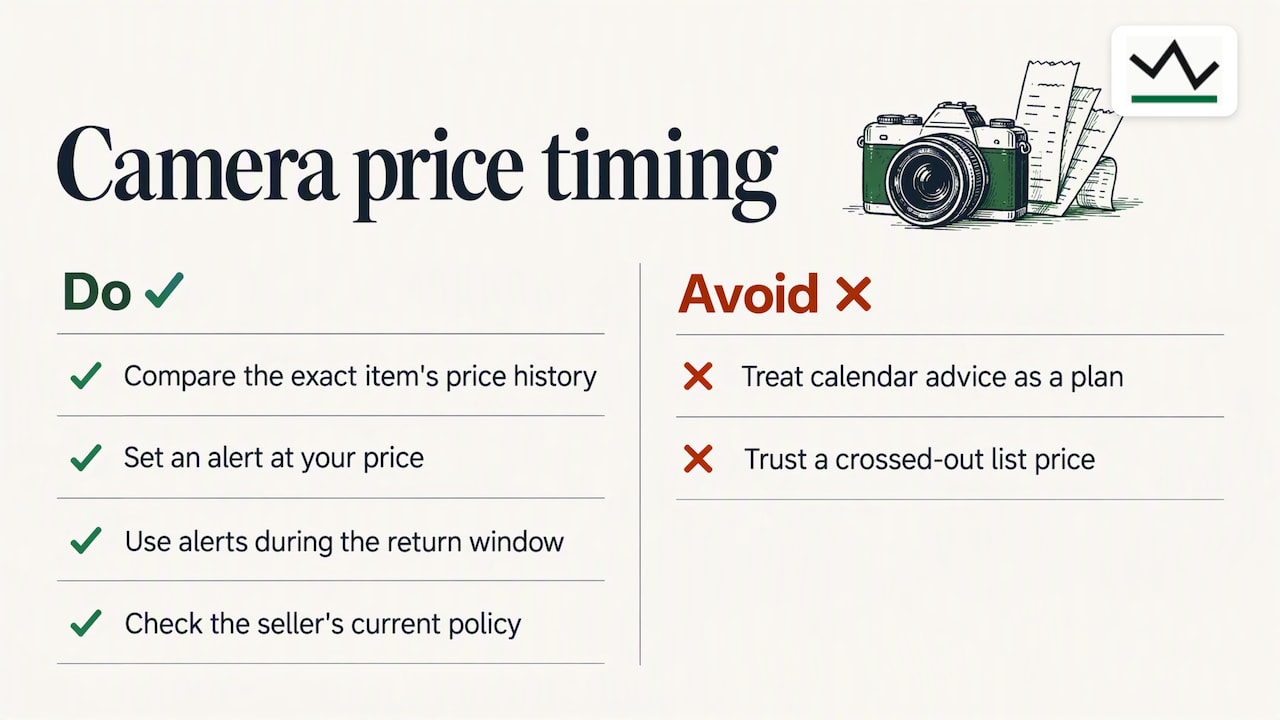
Third, buying is not the end of the timing question. Our alerts include a trigger for price drops within a return window after purchase, so if the price falls after you buy, you can find out while a return or price adjustment is still possible. Check the seller's current policy for what is allowed.
Finally, you do not need an account for our browser notifications. Pick the camera, set the price you would pay and let the alert do the watching.
— Cleaning
How to verify a camera deal is real
A deal is only as good as the price it replaces. Use this short check before you buy.
- Look at the price history. Open the product's history and see the lowest price over the last several months, not the label on the product page. Our Amazon price alerts guide explains how to verify drops with up to a year of data.
- Compare the body-only and kit prices. A kit with a lens can cost little more than the body alone, and the lens may be worth a lot.
- Check bundles. Some holiday bundles include cards, bags or batteries that you would otherwise buy. Others just add accessories you do not need.
- Confirm the return window. Cameras are expensive enough that you want a clear return policy for testing.
- Check the model's age. A deep discount on a model that has just been replaced is usually good news. A deep discount on a camera released a few months ago may signal a problem or a clearance of unsold stock, so read recent reviews.
One caution from the dynamic pricing research: Consumer Reports notes that leaving an item in your cart can sometimes trigger a coupon or price drop, but that it can backfire if the system detects high demand. Treat it as an experiment on items you can afford to lose, not a strategy for the one camera you must have.
Let an alert do the waiting
If you want a camera but not a calendar reminder, start from the Amazon price tracker. Paste a product, choose your target price and get a browser notification when it hits that mark, with no sign-up needed. You can also ask for back-in-stock alerts, which helps with popular bodies that sell out in the holidays.
To see what you would be tracking, browse camera prices, which typically run from $111 to $1,314 as of October 2026, or look at Canon camera prices if you are leaning toward that brand. We also keep a page on the best time to buy a camera in 2026 that is updated as the season moves.
FAQ
What is the best month to buy a camera?
November is the best bet for headline holiday discounts, and January is a strong second because of post-holiday clearances. A month can be beaten by timing, though: the weeks after a successor announcement often bring the deepest cut on the older model.
Do cameras get cheaper on Black Friday?
Often, yes, especially popular mirrorless bodies and kits, but not always the lowest price of the year. This year some Nikon models were already at record lows in October, per Digital Camera World. Compare against the item's price history to see whether a Black Friday price is actually a good one.
Should I wait for the next model before buying?
If you do not need the camera now and a successor is likely soon, waiting can save money on the older model. If you have a trip, a job or a broken camera, buy at a good price now. A new model's extra features may also be minor for how you shoot.
Is it better to buy a DSLR or mirrorless camera in 2026?
For most buyers, mirrorless, since it accounts for the vast majority of interchangeable-lens shipments and gets the newest development. A DSLR can still make sense if you already own lenses for it or find a good used one, but expect less choice and fewer deep discounts.
Sources
- Should you wait for the next camera release or buy now? (DPReview)
- Play the Dynamic Pricing Game to Win (Consumer Reports)
- Do you need a new camera to improve your photography? (Imaging Resource)
- When is the Best Time to Buy a Camera? (Expert Photography)
- Nikon Z8 and other Nikon cameras at lowest-ever prices (Digital Camera World)
- The world takes trillions of photos (Webiano)
- Mirrorless Camera Statistics 2026 (Discovercameras)