
A sale is a temporary price cut, and the price usually goes back up when it ends. Clearance is a retailer's effort to move inventory out for good, so the item is not coming back at full price and often not coming back at all. Clearance is usually deeper, but it is also more likely to carry tighter return rules. Neither label guarantees a good price, so the only reliable check is the item's real price history.
TL;DR
- Sale: a temporary discount on current merchandise. The price returns to normal afterward.
- Clearance: a permanent markdown on stock the store wants gone, usually discounted deeper as time passes.
- Returns: clearance is more often final sale or exchange-only, but the label alone does not decide it. Read the return policy at checkout.
- Price: both can be fake bargains. Compare against recorded price history, not the crossed-out number on the tag.
- Timing: sale prices expire on a date. Clearance ends when stock runs out, so waiting for a deeper cut is a gamble on availability.
Table of Contents
- The core difference: temporary versus permanent
- Why retailers put items on clearance
- Is clearance cheaper than a sale?
- Does clearance mean final sale?
- Will clearance items come back?
- How to tell a real deal from a label
- Timing: when each one shows up
- Worked examples
- Our perspective
- Track the price instead of chasing the label
- FAQ
- Sources
The core difference: temporary versus permanent
The simplest way to separate the two is to ask what happens to the price next. A regular sale is tied to a promotion or an event, and prices go back up when it ends. Clearance is a one-way street: the item is being phased out of active inventory, and it will not return to full price.
That is why a clearance sale is not really a separate kind of event from a sale. It is one possible reason for a price cut. Think of "sale" as the broad category (any reduced price) and "clearance" as the specific motive (the store wants this stock off its books). Every clearance is a markdown, but not every markdown is clearance.
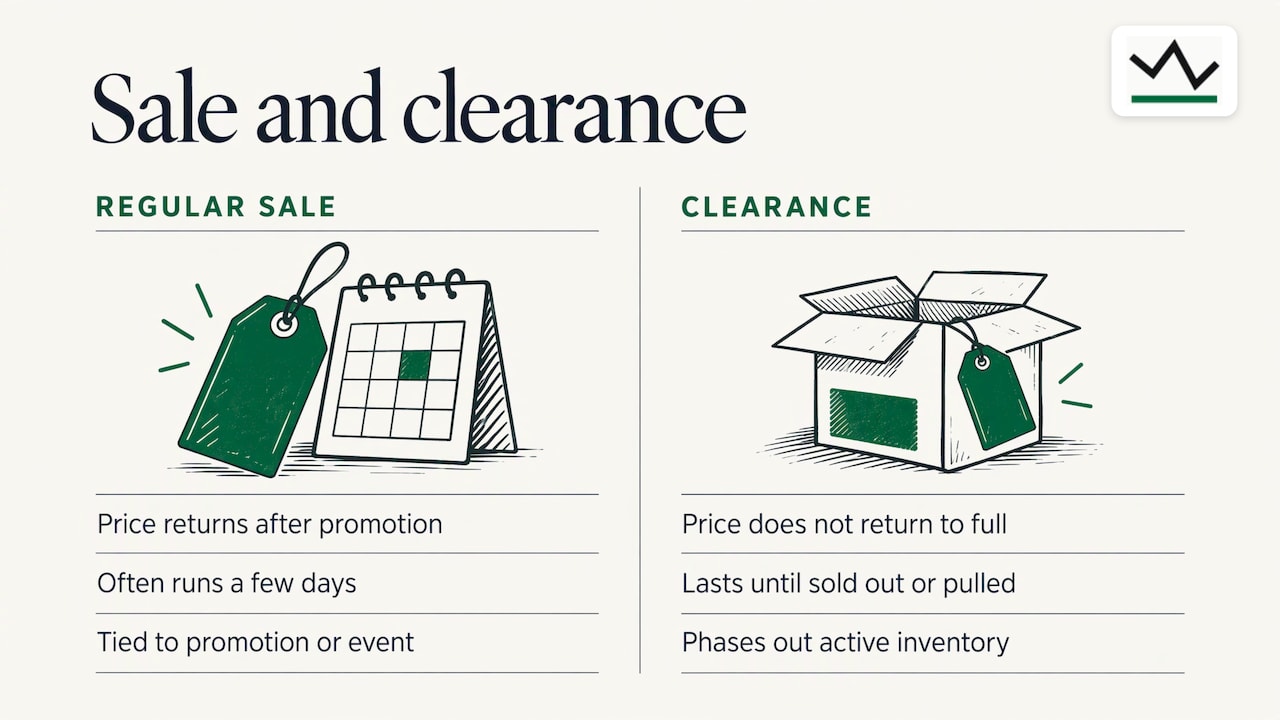
One trade source puts the timing contrast this way: store-wide sales often run only a few days, while clearance stays in effect until the item sells out or is pulled from the shelves. Treat those day counts as typical rather than universal, since every retailer sets its own calendar.
Quick comparison
| Sale | Clearance | |
|---|---|---|
| Duration | Limited, often with a stated end date | Open-ended, until stock is gone |
| Price afterward | Returns to regular price | Stays marked down, often drops further |
| Why it happens | Promotion, holiday, event, traffic | Overstock, end of season, discontinued items, new models arriving |
| Typical depth | Smaller cuts, often 5% to 50% | Often starts near 30% and deepens |
| Restocking | Usually restocked | Usually not restocked |
| Returns | Normally the store's regular policy | Sometimes final sale or exchange-only |
The depth figures in the table are patterns reported by retail suppliers, not rules. A given store can break them either way.
Why retailers put items on clearance
Stores do not mark things down out of generosity. Clearance covers end-of-season inventory, overstock, discontinued models and items with minor cosmetic flaws. Seasonal colors, packaging changes and last year's model when a new one arrives all end up in the same place.
From the store's side it is an inventory decision. A retail consultant explains that stores use clearance to recover some money on items that did not sell within a profitable window. Shelf space and warehouse space cost money, and new stock needs room.
The same logic applies well beyond clothing. Wholesalers and online sellers also run closeouts when a product line ends, for example closeout household items such as cleaning supplies, tableware and personal care products that are being moved ahead of a product refresh. If you shop for everyday goods, the clearance shelf is as much about stock cycles as about fashion seasons.
A closeout or clearance sale can also happen because a store is closing. The general definition covers products that are not selling well and stores that are relocating, over-ordering or going out of business. In the US, "clearance sale" is the standard phrase, and "closing down sale" is the British equivalent.
Is clearance cheaper than a sale?
Usually, yes, but not always. Clearance prices tend to start around 30% off and deepen over time, while ordinary sale pricing often ranges from 5% to 50% off.
How clearance markdowns step down
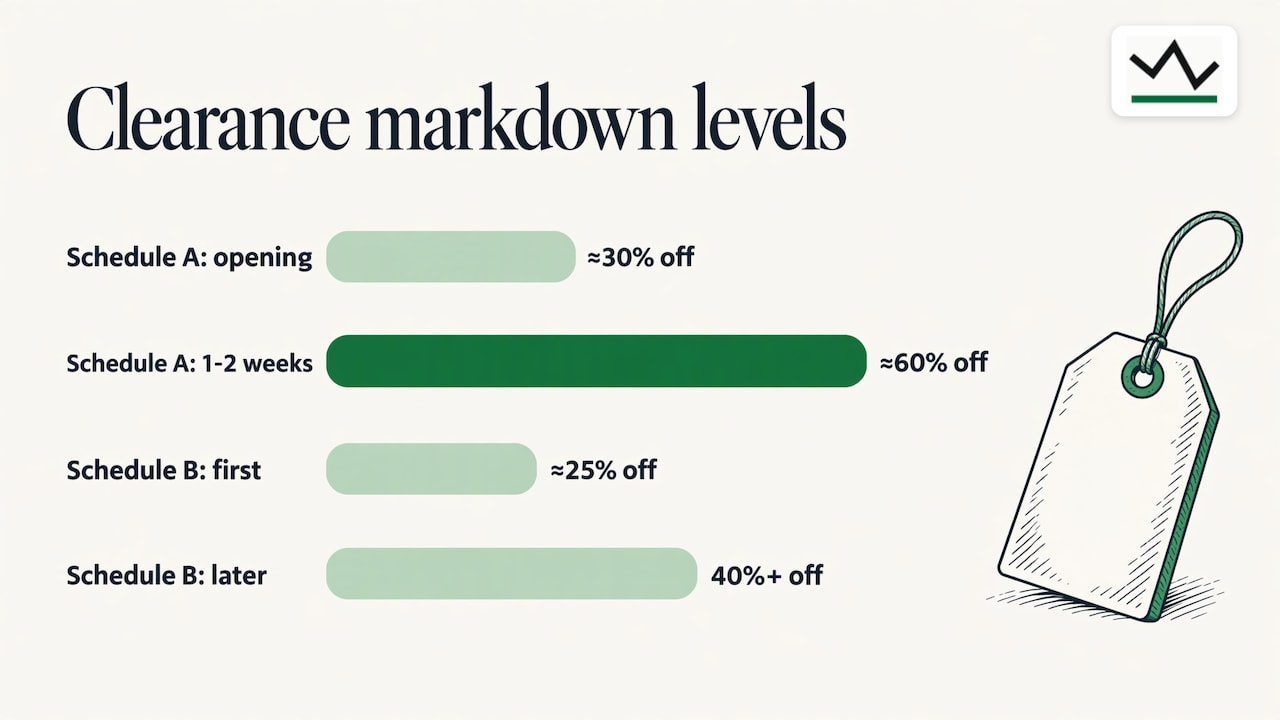
Most retailers follow a schedule rather than picking numbers at random. One breakdown describes retailers opening clearance at around 30% off, moving to roughly 60% after a week or two, and then donating or writing off what is left. Another describes a first markdown near 25%, then 40% or more a few weeks later, with at least three price movements before the final liquidation price.
Store-specific examples show how far it can go:
- Old Navy states that its clearance discounts typically run 50% to 85% off the original price, and that items marked "price as marked" stay at that price until sold out.
- Macy's describes permanently reduced merchandise as starting around 25% off and moving to 40%, 50% or more until inventory is gone.
- One guide to Ross describes red-tag clearance at 50% to 70% off and final yellow-tag items at 80% to 90% off.
Notice the pattern: the later you buy, the less you pay, but the thinner the selection. The lowest price usually belongs to the sizes, colors and models nobody wanted first.
When clearance is not actually cheaper
The word "clearance" is not a price guarantee. In March 2025, a report on Walmart shoppers described toothpaste and soap on a clearance shelf at the same price as in their regular aisle, and other items only 10% or 20% off. In May 2026, a New York Post report described extension cords with clearance stickers that were slightly higher than the original price hidden behind the tag.
These are shopper reports, not proof of a store-wide practice. They still make a useful point: a clearance tag tells you the store's intent, not the real discount. The only fair comparison is the price the item actually sold for over recent weeks and months.
Does clearance mean final sale?
Not automatically. Clearance describes the pricing. Final sale describes your rights after you pay. Retailers often pair the two, but the final-sale restriction has to be explicitly stated to apply. Many trade sources say clearance items are typically nonrefundable, which is a pattern, not a rule.
Examples of how it varies:
- Living Spaces allows returns on clearance furniture within seven days, with exceptions such as mattresses, pillows, sheets and as-is items or floor models.
- Macy's "Last Act" items are described as final sale with no returns or exchanges, and the tag says so or ends in a specific cents pattern.
- Many retailers restrict final-sale clearance to exchanges only, so check the policy before buying, especially above $50.
If an item arrives broken or non-functional, a final-sale label does not necessarily end your options. One legal explainer notes that implied warranty rules can still apply to defective goods. If you hit that situation, your state attorney general's consumer protection office is the place to ask what applies to you.
A practical rule for returns
For anything where fit or taste matters, such as shoes, apparel and gifts, a slightly higher sale price with an easy return policy can beat a non-returnable clearance item. For items with fixed specs, such as a charger, a camping stove or a set of tools, the return risk is lower, so clearance is often the better place to look. Confirm the specifications first, because a liquidating retailer cannot absorb return costs.
Will clearance items come back?
Almost never in the same form. Macy's says clearance, closeout and similar offers are limited to stock on hand, available while supplies last, because the item is often being cleared and will not be reordered. Living Spaces states that a clearance item is not restocked and is discontinued once sold out.
That changes how you should think about waiting. With a sale, waiting for the next event is a reasonable bet because the item is still around. With clearance, each week of waiting may bring a lower price, or it may bring an empty shelf. The decision comes down to how replaceable the item is.
How to tell a real deal from a label
A tag is a claim made by the seller. A price history is a record. Here is a short routine that works for either sale or clearance pricing.
- Check the price over time. Look at what the item cost over the last several weeks, not just the "was" price. If it was at this level two weeks ago, it is not a fresh drop.
- Look for the item's cycle. Products tend to dip around known events and when a successor model appears. Our guide on five price history checks to spot sale noise walks through the signals.
- Read the return terms at checkout. Look for "final sale", "as is" or "exchange only" before you pay.
- Compare against a non-clearance alternative. If a current-model item on a short sale is close in price, it may be the safer buy.
- Weigh condition. Clearance sometimes includes open-box or cosmetically imperfect goods. See what you save and what you risk with open box before you decide.
Reading price tags in stores
Tags and labels carry clues. Terms like Original, Closeout, Clearance, Now, Permanent Markdown or Just Reduced signal that the price will not return to the original. A "sale" or "special purchase" tag points to a promotion. Ending prices such as .96 can also indicate a final markdown at some stores, but this varies by retailer, so use it as a hint and not a rule.
Timing: when each one shows up
Sales cluster around a calendar. Clearance clusters around inventory cycles. In practice that means:
- Sale events appear around predictable moments. Look at the recurring patterns for Memorial Day, Fourth of July, Labor Day, the Amazon Big Spring Sale, Prime Big Deal Days and Green Monday. Dates shift from year to year, so confirm the current schedule on each retailer's official page.
- Clearance tends to follow the end of a season or a product refresh. For outdoor gear, our page on the best time to buy sports and outdoor gear shows how prices move through the year.
The overlap is where the best prices happen: a clearance item that also gets pulled into a holiday promotion can fall further. It does not happen to every product, which is exactly why watching beats guessing.
Worked examples
These are illustrative scenarios, not real listings.
The camping stove. A model is replaced by a newer version. The old one is marked 30% off, then 50% off two weeks later. The specs are fixed and you already know them. Clearance is the right place to buy, and waiting for the second markdown is a fair bet if several units are in stock.
The winter jacket. Last season's color goes on a sale at 25% off for a weekend, with the regular price returning on Monday. A clearance rack at another store has the same jacket at 60% off, final sale. If you know your size and fit, take the clearance. If you are unsure, the sale price with free returns can be the cheaper choice once you count a possible mistake.
The everyday item. A shelf labeled clearance holds a household product priced the same as the regular aisle. The label is doing the selling, not the price. Skip it and compare against recent prices.
Our perspective
We built BasketPrice around one idea: a discount means something only if you can see what the price was before it. Sale and clearance are both labels that the seller chooses. That is why we publish price records from our own recorded readings instead of relying on merchant claims.
In our view, the sale-versus-clearance question is really a timing and evidence question. A sale tells you the price may come back. Clearance tells you the item may not. Either way, the useful move is to know the item's history and set an alert at the price you would be happy to pay.
Our alerts are built for this. You can get browser notifications for price drops with no sign-up required, and our triggers include price drops after purchase while you are still inside a return window. If you buy during a sale and the price falls again, that is something worth knowing about while a return or adjustment is still possible.
Cleaning
Track the price instead of chasing the label
If you have an item in mind, you do not need to check it every day. With our Amazon price tracker and price drop alerts, you can follow a product, see its recorded history and be notified when the price moves or when it is back in stock. You can also browse current prices checked against their own history across categories such as electronics, sports and outdoors, home and car products.
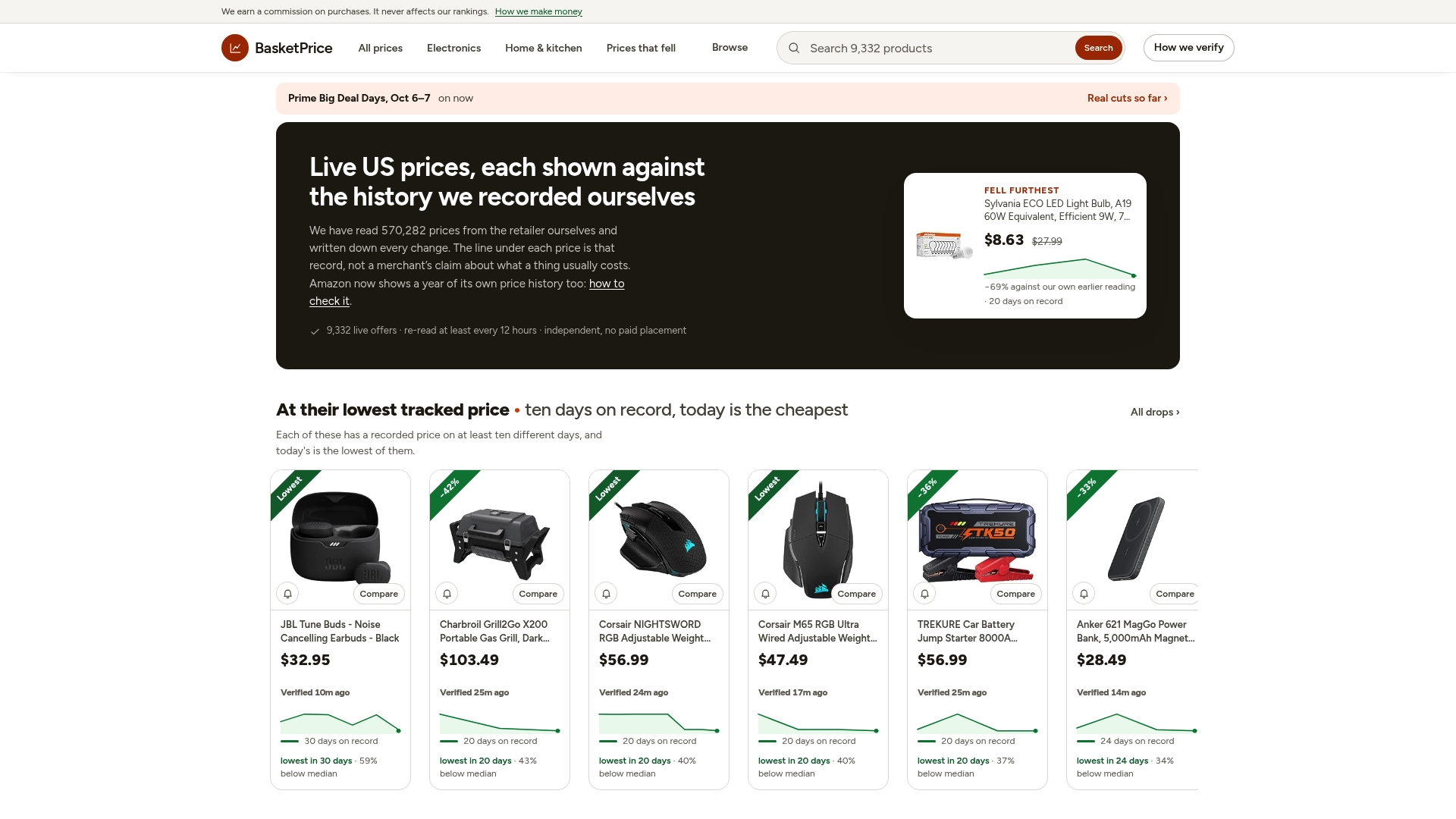
If you are comparing a clearance price with a current sale price on the same product, start with the history and let the numbers decide. When a purchase goes through a retailer link on our site, we may earn a commission, which is how we keep the tracking free to use.
FAQ
Is clearance cheaper than sale?
Usually, yes. Clearance often starts around 30% off and deepens over time, while regular sale discounts tend to be smaller. The label is not a guarantee, though, so compare against the item's recent price history before assuming a deal.
Does clearance mean final sale?
No, not by itself. Clearance describes the pricing, and final sale is a separate return restriction that the retailer has to state. Many stores do pair them, so check the return policy before you pay, especially on higher-priced items.
Do clearance items come back?
Typically not. Clearance stock is limited to what is on hand and is generally not reordered, so once it sells out the item is gone. That is why a price alert helps: it tells you when the price moves before the stock does.
Is it correct to say "clearance sale"?
Yes. It is a standard American phrase for a discount event meant to move inventory quickly, whether the store is clearing a season, an overstock or a discontinued line. In the UK, the equivalent phrase you will often see is "closing down sale".
Sources
- DontPayFull: What Is a Clearance Sale?
- WhatsonClearance: Sales vs Clearances
- American Retail Supply: Sale vs Clearance
- RetailDoc: Making Friends With Clearance Sales
- Wikipedia: Closeout (sale)
- Couponzania: What Is a Clearance Sale?
- Old Navy: Clearance
- TimeToBuying: Ross clearance markdowns
- The Daily Dot: Walmart clearance items
- New York Post: Walmart clearance pricing
- LegalClarity: Does Clearance Mean Final Sale?
- Living Spaces: Clearance Furniture FAQ
- Purchy: Macy's return policy
- Edeal Directory: Outlet vs Sale vs Clearance
- Shop Till You Drop: Shopping Smart in the USA
- Bulk Price: Closeout household items