

Dynamic pricing means an online store changes the price of the same item again and again, sometimes several times a day, based on demand, stock, competitors and shopper data. It is legal and everywhere, and it is the reason the price you saw yesterday may not be the price you see today. You can't stop it, but you can beat it by checking an item's real price history before you pay.
TL;DR
- Dynamic pricing is frequent, automated price adjustment driven by demand, inventory, competitor prices and click data. It is not the same as a one-off sale.
- Personalized pricing is a different thing: it charges different people different prices based on who they are or how they behave. The FTC has reported that retailers can use a wide range of personal data for this.
- The biggest everyday trap is the inflated "was" price: a price raised shortly before a sale so the discount looks bigger than it is.
- The fix is simple: look at 90-day and 365-day lows, set an alert for your target price, and buy only when the current price is near the low.
Table of Contents
- What dynamic pricing online actually is
- How dynamic pricing works: the inputs
- Amazon dynamic pricing: what is really going on
- The traps: when a price drop is not a deal
- Perspective: what we have learned watching prices
- A five-step routine to beat dynamic pricing
- Where tracking pays off most
- Track prices with BasketPrice
- Is dynamic pricing good or bad?
- FAQ
- Sources
What dynamic pricing online actually is
A business uses dynamic pricing when it frequently adjusts a product's price over short periods in response to changing market conditions. Think of airline seats and ride-hailing, then apply the same logic to a blender, a pair of headphones or a tent. Software watches the market and moves the price up or down without a person approving each change.
It helps to separate three ideas that get mixed up:
| Concept | What changes the price | Does it depend on you personally? |
|---|---|---|
| Dynamic pricing | Market conditions: demand, supply, competitor prices, time | No, everyone sees roughly the same price at a given moment |
| Personalized pricing | Your characteristics and behavior: location, browsing, history | Yes |
| A regular sale | A planned, time-limited discount from a reference price | No, but the reference price may be inflated |
The distinction matters. A Department of Justice background note describes how personalized pricing charges consumers different prices based on personal characteristics and conduct, while dynamic pricing adjusts to changes in demand and supply, often in real time, without implying discrimination between consumers. In practice, companies can mix both: academic research notes that firms may adjust prices in real time while also offering individualized discounts based on loyalty data or behavior.
How dynamic pricing works: the inputs
Most online price changes come from a short list of signals.
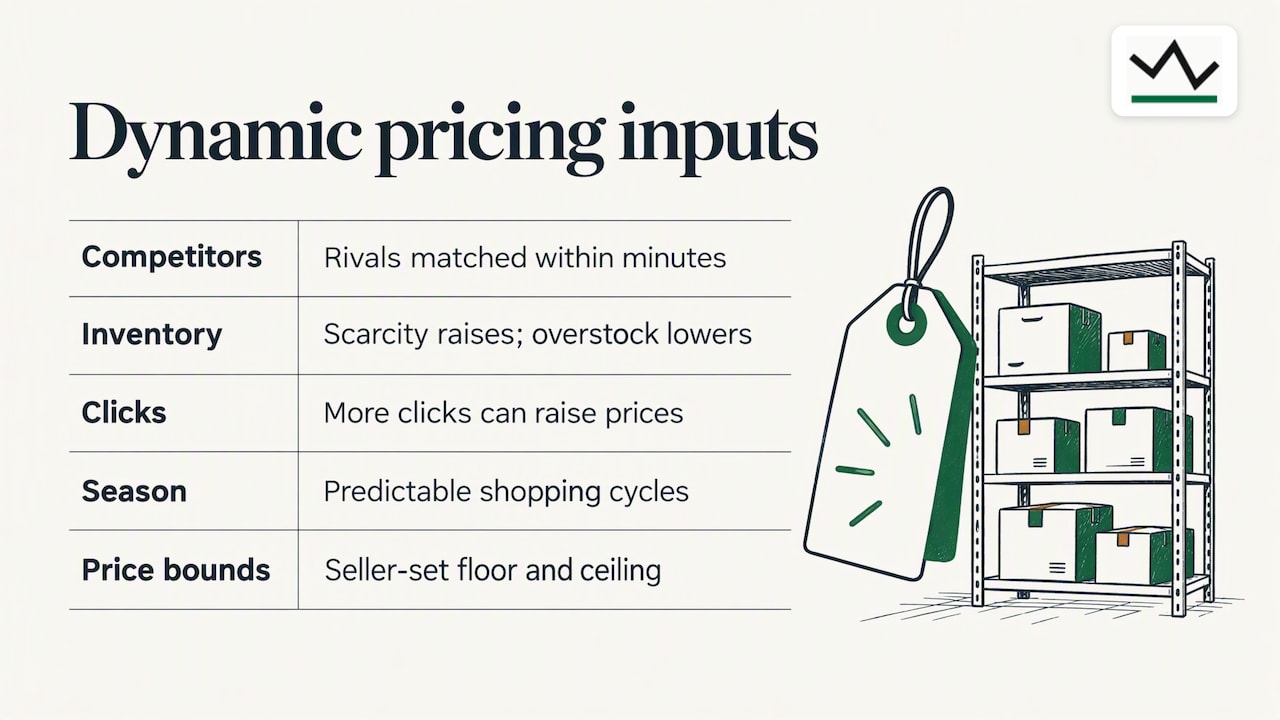
Competitor prices. If a rival drops a price on a popular item, repricing software can match or undercut it within minutes. This is the main reason prices on the same product bounce around between big retailers.
Inventory levels. Scarce stock tends to hold or raise a price. Overstock tends to push it down. A product that is nearly sold out rarely gets cheaper.
Demand and click data. Research on digital pricing explains that online retailers can use competitor prices, inventory levels, and real-time click and transaction data, and that a rise in clicks can lead to a price increase. A product going viral can get more expensive for exactly that reason.
Season and timing. Back-to-school, holiday weeks, and end-of-model-year clearances create predictable waves. If you shop for a category with a known cycle, our guide to the best time to buy electronics and the equivalent for sports and outdoor gear show what those cycles look like.
Price bounds. Sellers usually set a floor and a ceiling so the algorithm can't go below cost or above what the market will bear. That is why you often see the same product oscillate between a few familiar numbers rather than wander randomly.
If you want a look at the same mechanics in a market where it is most visible, this dynamic pricing savings checklist for event tickets shows how surge-style pricing plays out when demand spikes.
Amazon dynamic pricing: what is really going on
Amazon is the retailer most shoppers have in mind when they ask about this, and it is also where we see the most price movement. Millions of listings come from both Amazon and third-party sellers, many of whom use repricing tools. The result is that a single product can change price repeatedly in a day, and the "lowest" price can belong to a different seller from one hour to the next.
Two things are worth separating.
The price changes over time. This is standard dynamic pricing. Everyone looking at the listing at the same moment generally sees the same price, and the price moves as conditions move.
Different shoppers seeing different prices. This is personalized pricing, and Amazon has history here. In 2000, Amazon offered different prices to randomly selected customers on a test group of 68 DVDs, then refunded 6,896 customers who paid higher test prices after complaints. That was a quarter century ago, so it says little about how Amazon prices today, but it shows why shoppers stay alert.
More broadly, the FTC's staff study found that details such as precise location or browsing history can frequently be used to target individual consumers with different prices across the retail market. The study looked at the intermediaries that sell this capability, not at one store, so treat it as a reason to compare, not as proof that any particular site is doing it to you.
The practical answer for Amazon is the same either way: stop trusting the number on the page and start trusting the record behind it. Our walkthrough on how to track Amazon prices over 365 days and then verify the "was" price covers exactly that.
The traps: when a price drop is not a deal
Dynamic pricing is mostly neutral. The damage comes when moving prices are combined with discount labels. Here are the traps we see most.
The inflated reference price
Wirecutter describes this plainly: in anchored pricing, retailers raise prices before a sale so the discount appears larger than it is. The item can then end up at its typical price, or with only a marginal discount. A "40% off" badge tells you the gap between the current price and a reference price. It tells you nothing about whether that reference price was ever real.
Sale prices that are always on
Consumers' Checkbook tracked national chains for months and found that 21 out of 25 advertised sale prices more than half the time. Its Kevin Brasler argues that because items are rarely sold at a "regular" price, percentage-off discounts have lost their meaning, and comparison shopping is the reliable way to find the best deal. An earlier look by the same group, reported by Consumer Reports, found that some retailers consistently offered legitimate discounts while others frequently used misleading sale labels.
No one tells you the price is dynamic
The UK's Competition and Markets Authority reported that most businesses it engaged with did not expressly tell consumers they used dynamic pricing or how they set prices. That finding is about the UK, but the lesson travels: do not expect a store to warn you that a price is about to change.
Who decides what a fake discount is
In the US there is no single bright line. Nebraska attorney general's office staffer Meghan Stoppel has pointed out that federal law does not define a "reasonable period" for anchor prices, so states judge deceptive pricing case by case. That is one more reason to do your own check instead of waiting for a regulator.
Urgency timers and "only 3 left"
Countdown clocks and low-stock banners push you to decide before you compare. Sometimes they are accurate. If the item was at this same price two weeks ago and will be again, the urgency was manufactured. A glance at history settles it in seconds.
Perspective: what we have learned watching prices
We built BasketPrice around one belief: a price only means something next to its own history. Merchants describe their discounts in their own words, and those claims are hard to check. So we publish price records based on our own recorded readings, not on what a merchant says the "regular" price was.
That approach shapes our advice. A drop is only interesting if it is close to the 90-day or 365-day low. A "deal" that matches the price from three weeks ago is noise. And the moment of purchase is not the end: if a price falls again inside your return window, you may be able to return and rebuy, which is why our alerts can trigger on post-purchase price drops.
We also think tracking should be low-friction. Browser notifications work without sign-up, so you can follow an item without handing over an account. Busy people don't have time to refresh product pages, and they shouldn't have to.
— Cleaning
A five-step routine to beat dynamic pricing
You don't need to understand an algorithm to outsmart it. You need a routine.
- Check the history before the badge. Open the price history and look at the last 90 days and the last 365 days. Our guide to checking price history for 90-day and 365-day lows explains how to read the chart.
- Find the typical price, not the list price. If an item spends most of the year at $60 and the "original" price is $100, the real discount from a $50 sale is about $10, not $50.
- Set a target and wait. Pick a price near the historical low and set an alert. Amazon price alerts verified with up to a year of price data take the waiting off your plate.
- Run the buy-or-wait test. Is the price at or near the low? Is a major sale event coming? Is the model about to be replaced? Our buy now or wait checklist walks through five checks that separate real drops from sale noise.
- Compare on unit price. Multipacks and bundles can hide a worse deal. See how to compare unit prices online using price history.
A worked example
Say a pair of wireless earbuds shows $79.99, crossed out from $129.99, with a red "38% off" badge. You open the history and see this pattern over a year: mostly $84 to $95, a dip to $74.99 for a few days in spring, and a short spike to $129.99 two weeks before the badge appeared.
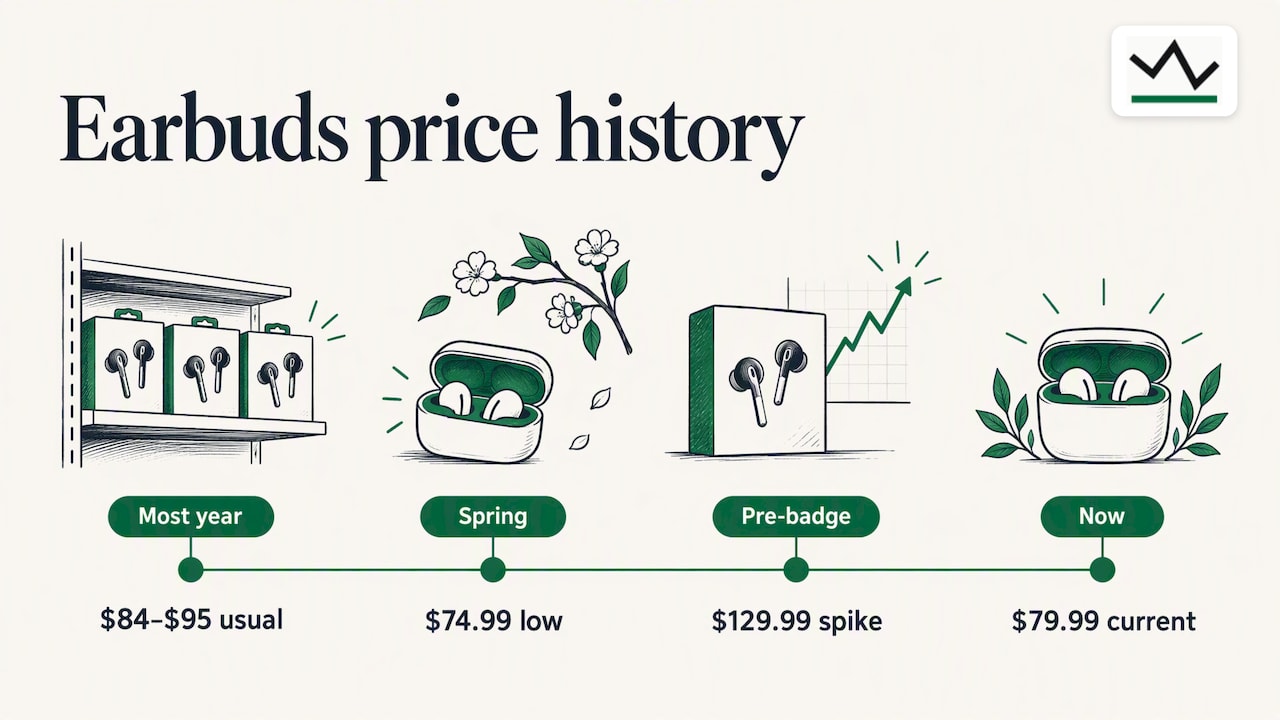
The discount is real in the sense that $79.99 is below the current list. It is not much of a deal, though: you'd save a few dollars off the usual price, and the spring low was cheaper. With an alert set at $75, you wait. If it never reaches your target, you have lost nothing, and you buy at the usual price knowing exactly what you paid for.
Guarding against personalized pricing
While personalized pricing is harder to prove from the outside, a few habits cost nothing:
- Compare the same listing in a private window and on a different device before a large purchase.
- Compare against the recorded price history, which does not depend on your browser profile.
- Add the item to your cart and leave it only if you are willing to wait; an abandoned cart is one of the behaviors the FTC's staff study found can be tracked.
- Check whether a seller is Amazon itself or a third party, since the price history can differ by seller.
These are precautions, not proof of anything. If you suspect a specific store of deceptive pricing, your state attorney general's consumer protection office is the place to report it.
Where tracking pays off most
Dynamic pricing moves some categories far more than others. Electronics and tech accessories change constantly because competitors reprice against each other. Our electronics price page shows typical prices of $79 to $650 as of October 2026, and the smart home section typically runs $27 to $100. Outdoor gear is more seasonal; the sports and outdoors page lists typical prices of $22 to $120 in October 2026. Car care and car electronics also swing, with car electronics typically $42 to $160.
These ranges are snapshots, not promises. Prices will have moved by the time you read this, which is exactly the point of tracking.
Track prices with BasketPrice
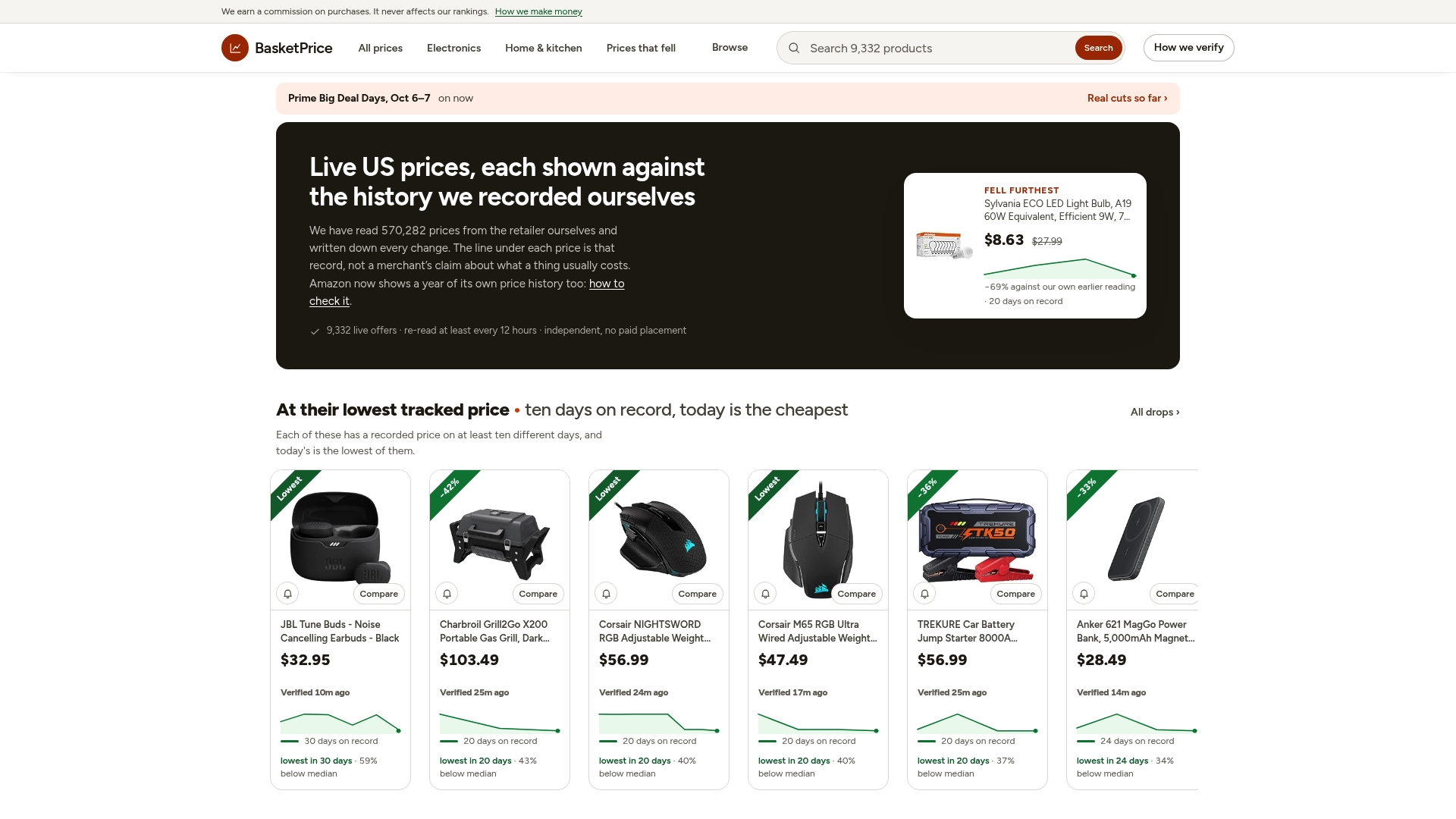
If you shop on Amazon, you can do the whole routine in one place. BasketPrice shows price history based on our own recorded data, lets you track a specific item, and sends a browser notification when the price drops or the product comes back in stock. Start with the Amazon price tracker with price drop alerts, or browse what is moving on the BasketPrice homepage.
We earn a commission when you buy through our links after tracking an item, which is why we only get paid when a deal is genuinely worth clicking. If you are weighing us against a browser coupon extension, our page on a Honey alternative for price tracking explains the difference between finding coupon codes and verifying price drops.
Is dynamic pricing good or bad?
It depends on which side of the screen you are on, and honest advice admits both. Sellers use it to clear stock, respond to competitors and avoid leaving money on the table. Shoppers sometimes benefit: prices fall when a competitor undercuts, when demand is soft, or when a new model arrives. Researchers describing the practice note that it adjusts to supply and demand without implying that individual customers are being singled out.
The problems come from opacity. When prices move constantly, labeled discounts mean less, and the shopper who doesn't check history pays for that gap. The more a price fluctuates, the more a record of those fluctuations is worth.
FAQ
What is dynamic pricing?
It is a pricing method where a seller adjusts prices frequently, often automatically, in response to demand, supply, competitor prices and timing. The same item can cost more on Monday than on Friday without any sale being involved. It differs from personalized pricing, which depends on who the shopper is.
Is dynamic pricing legal in the US?
Adjusting prices over time is generally lawful. The legal risk comes from deceptive practices, such as advertising a discount from a price the item was never really sold at. Because federal law does not define a "reasonable period" for reference prices, states handle many of these cases individually. If you think a price claim is false, contact your state attorney general's consumer protection office.
Does Amazon charge different people different prices?
Amazon's prices do change many times over days and weeks, and that is dynamic pricing. A well-documented 2000 test showed Amazon charging different customers different prices for DVDs, after which it issued refunds. For any current purchase, the most reliable check is to compare the price against recorded history rather than rely on one page view.
How can I tell if a sale price is real?
Compare it with the 90-day and 365-day lows and with the item's typical price. If the "sale" price equals what the item sold for a few weeks ago, the discount is mostly marketing. A tracker with its own recorded data makes this a ten-second check.
Can I avoid dynamic pricing altogether?
Not really, but you can work with it. Set a target price, wait for the item to reach it, and buy near the historical low. If a price drops again after you buy, check whether you are still inside the return window.
Sources
- Dynamic Pricing: a Consumer Scotland insight report
- Personalised Pricing in the Digital Era, background note (US Department of Justice)
- Pricing in the Digital Age (University of Groningen white paper)
- Sorry We Did It, Glad We Were Caught (CBS News)
- FTC Surveillance Pricing Study press release
- Why Most Deals Aren't Actually Worth It (Wirecutter)
- Sale Fail: Consumers' Checkbook sale price tracking
- When Are Sales Too Good to Be True? (Consumer Reports)
- Update: dynamic pricing (GOV.UK)