
Amazon's Pre-order Price Guarantee means you pay the lowest price Amazon.com offers between the moment you place a qualifying preorder and the end of the item's release day. If the price falls, you get the lower price. If it rises, you keep the price you saw. The catch is that only certain items qualify, and some lower prices don't count.
This guide covers what qualifies, when your card is charged, how the adjustment shows up, and how to confirm you got it. It also covers what to do when an item doesn't carry the guarantee.
TL;DR
- The guarantee applies to not-yet-released items sold by Amazon.com that show the "Pre-order Price Guarantee" message on the product page.
- You pay the lowest Amazon.com price between your order and the end of release day (physical items) or the moment of release (digital content).
- Prices that require joining a program to get them are not covered, and neither are third-party sellers.
- Amazon generally charges your card once the order enters shipping, and the price adjustment is automatic. Check Your Orders to confirm.
- Once the release window closes, later price drops are not covered. A price tracker helps you decide when to buy and when to hold.
Table of Contents
- What the Pre-order Price Guarantee actually promises
- Which preorders qualify
- When Amazon charges you for a preorder
- How the price adjustment reaches you
- How to check you paid the guaranteed price
- What the guarantee doesn't cover
- Is preordering cheaper?
- Perspective
- Tracking prices around a preorder
- Smart habits for any preorder
- Find your next deal on BasketPrice
- FAQ
- Sources
What the Pre-order Price Guarantee actually promises
Amazon's help page on the guarantee states it plainly. For a qualifying item that hasn't been released and is sold by Amazon.com, the price you're charged is the lowest price Amazon.com offered between the time you ordered and the end of the day of the release date. For digital content such as games, software downloads, Kindle books and Amazon Music, the window ends when the content is released.
That gives you two things at once:
- Protection from drops. If Amazon cuts the price after you order, you pay the cut price.
- Protection from rises. If the price goes up, you still pay the lower price you locked in when you ordered.
It is a price-lowest-wins rule, not a price freeze. The charge isn't fixed at the number on your screen. It tracks the lowest number Amazon showed during the window.
The window has a hard end
The window closes at the end of release day for physical goods. Anything that happens after delivery falls outside the guarantee. If a deal appears two weeks after launch, a preorder made before launch doesn't get it. That timing matters when you decide whether to preorder at all, and we come back to it below.
Which preorders qualify
Look for the message on the product detail page. Amazon says qualifying items display the "Pre-order Price Guarantee" text. No message, no guarantee. Don't assume it from the fact that an item is listed as "Pre-order" or "Available for pre-order."
| Situation | Covered? |
|---|---|
| Not-yet-released item sold by Amazon.com with the guarantee message | Yes |
| Digital game, Kindle book or music preorder with the message | Yes, until the content releases |
| Item sold by a third-party seller | No, the guarantee is for items sold by Amazon.com |
| A lower price that requires joining a program to receive it | No |
| Item already released | No |
The program exclusion trips people up. Amazon's help page says the guarantee does not apply to lower prices offered through any program that requires you to join in order to get the price. If a discount is only for members of some program, it isn't the price the guarantee is measured against.
The seller line is also worth reading before you click. On a product page, "Ships from" and "Sold by" tell you who the seller is. The guarantee message is the confirmation you're looking for.
When Amazon charges you for a preorder
People often worry that a preorder means paying months early. For Amazon-sold items it generally doesn't. Amazon's Conditions of Use say it does not generally charge a credit card until the order has entered the shipping process or, for digital products, until the product is made available to you.
In practice that means your card is charged a few days before release, around when the item ships, depending on the item. Business Insider's explainer on Amazon preorders describes the same timing. A temporary authorization may appear when you order, but that is a hold, not the final charge.
Two practical points follow:
- Bundled orders can bill sooner. If your preorder shares an order with in-stock items, the whole order can ship, and be billed, earlier than the preorder alone would be. If you want a clean release-day charge, place the preorder by itself.
- A pending line isn't the final price. Look at the final charge after shipment, not the hold.
Other stores handle this differently. Some bill at order, some at shipment. Smaller retailers publish their own rules, and a page on pre-order billing timing shows the kind of detail worth finding in any store's shipping FAQ before you commit money to a preorder.
How the price adjustment reaches you
You don't file a claim. According to Amazon's promotion terms for the guarantee, the order summary in Your Account reflects the lowest price within 24 to 48 hours of a price change if the product hasn't shipped yet. After shipment, the difference between your order price and the lowest price by the end of release day is refunded automatically, typically within 24 to 48 hours after the release date.
The same terms say a guarantee message appears on the Order Summary during checkout. If you order with 1-Click, the guarantee is applied automatically.
A simple example
Say you preorder a console accessory at $59.99. A week before release, Amazon drops it to $49.99. The day before release it climbs to $54.99. The lowest price Amazon.com offered in the window was $49.99, so that's what you should pay. If you were charged $59.99 at shipment, the $10 difference should come back automatically. The numbers are illustrative, not a real listing.
How to check you paid the guaranteed price
The guarantee works on its own, but it is quick to verify. Do this:
- At order time, screenshot the product page showing the guarantee message and the price.
- During the wait, open Your Orders now and then. Before shipment, the order total should follow the lowest price within about 24 to 48 hours of a change.
- After release, compare the final charge with the lowest price you saw. Allow the 24 to 48 hours Amazon's terms describe for the refund.
- If it's off, contact Amazon customer service with your order number and your screenshots.
The screenshots matter because you want a record of the price you saw. Amazon's own page changes constantly. That is where independent price history helps.
What the guarantee doesn't cover
Knowing the limits keeps you from counting on protection you don't have.
Price drops after release
The protection ends with the release window. A cut that lands after launch isn't part of it. Amazon states its position on pricing as everyday low prices and says it does not offer price matching compensation.
Cart prices
An item sitting in your cart is not reserved at that price. Amazon's shopping cart help page says cart items always show the most recent price on the product page, and the price may move up or down before you buy. The preorder guarantee applies once you place a qualifying preorder, not while it waits in a cart.
Mispriced items
The Conditions of Use also note that Amazon cannot confirm a price until you order and that a small number of items may be mispriced. If the correct price is higher, Amazon will either contact you for instructions before shipping or cancel the order. A guarantee on the lowest price doesn't make an obvious error price binding.
Other stores' preorders
Every retailer sets its own terms. The U.S. has no federal rule that gives you a right to cancel a preorder, so cancellation windows and refund conditions come from the retailer's policy. Read them before paying a deposit. Retailers that run price-match or price-adjustment policies attach their own conditions, such as how a store's price match policy defines eligible competitors and timing.
Is preordering cheaper?
On a qualifying Amazon item, preordering carries little price risk. You pay the lowest price in the window, so you aren't punished for ordering early. That makes it a reasonable way to secure launch-day delivery of something in demand.
Whether it is the cheapest route is a different question. The guarantee only follows prices up to release day. Many products see their first real discount weeks or months after launch. If you don't need the item on day one, a preorder buys certainty of delivery, not necessarily the lowest price you'll ever see.
Three questions settle most cases:
- Do I need it on release day? If yes, preorder a guaranteed item.
- Is this a category that tends to get discounted soon after launch? Past price patterns on similar items tell you. Our guide to five price history checks walks through how to read them.
- Does the item show the guarantee message? If not, treat the preorder price as the price you might be stuck with.
Perspective
We built BasketPrice around one idea: a price only means something next to the price history behind it. A guarantee that follows the lowest price until release day is useful, and we think every shopper should use it on items that carry it.
What the guarantee can't tell you is what happens next. It ends at release. Our records come from our own price readings, not from merchant claims, so you can see how an item moved before you decided to preorder or wait.
That's also why our alerts go beyond a simple drop. You can set price drop and back-in-stock alerts on specific items, and you can use browser notifications with no sign-up. We also built a trigger for a price drop after you've bought, so you know while you're still inside a return window.
Use the guarantee for the window it covers, and use the price history for everything around it.
Cleaning
Tracking prices around a preorder
The best use of a price tracker is to fill the gaps the guarantee leaves.
Before you preorder. Check how comparable earlier products or the same item's predecessor moved after launch. If a category usually drops quickly, you may prefer to wait. If it rarely does, preordering costs you nothing.
While you wait. Even with the guarantee, it helps to know when the price falls. It tells you the adjustment is coming, and you can compare it with the refund later.
After release. This is where the guarantee stops, so alerts do the work. A back-in-stock alert is useful for items that sell out at launch. A price-drop alert tells you when the item becomes a deal.
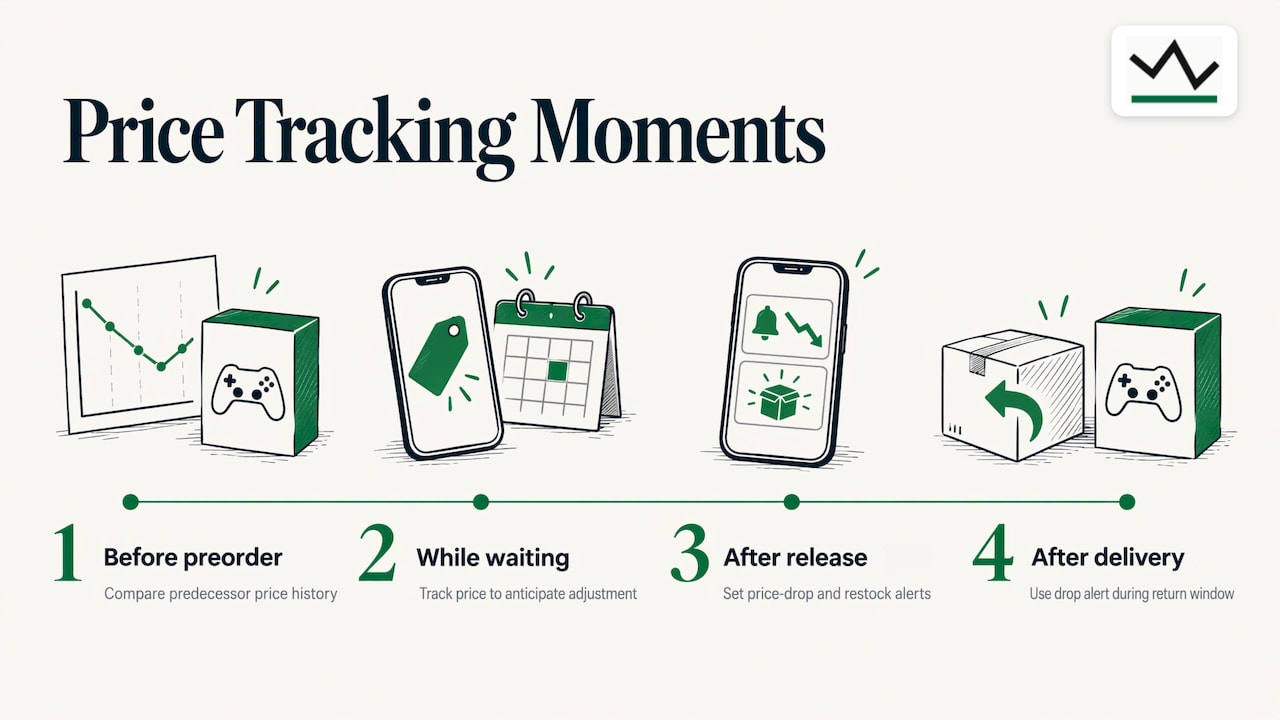
After you buy. If the price drops after delivery, you may still be inside a return window. A drop alert during that period gives you the option to return and rebuy where the retailer's policy allows it.
Smart habits for any preorder
- Order the preorder alone when you can, so billing follows the release schedule.
- Screenshot the guarantee message and the price at checkout.
- Pay with a card you check regularly, and watch for the final charge after shipment.
- Avoid program-only prices as your benchmark. The guarantee doesn't use them.
- Compare unit prices when a preorder comes in bundles or multipacks. Our guide to comparing unit prices with price history shows how.
Find your next deal on BasketPrice
If you're planning a purchase, start from what the price has actually done. BasketPrice tracks products across major online retailers, mainly Amazon, and shows records from our own readings. You can browse electronics deals, check Amazon device price history, or head to the BasketPrice homepage to track an item and set an alert.
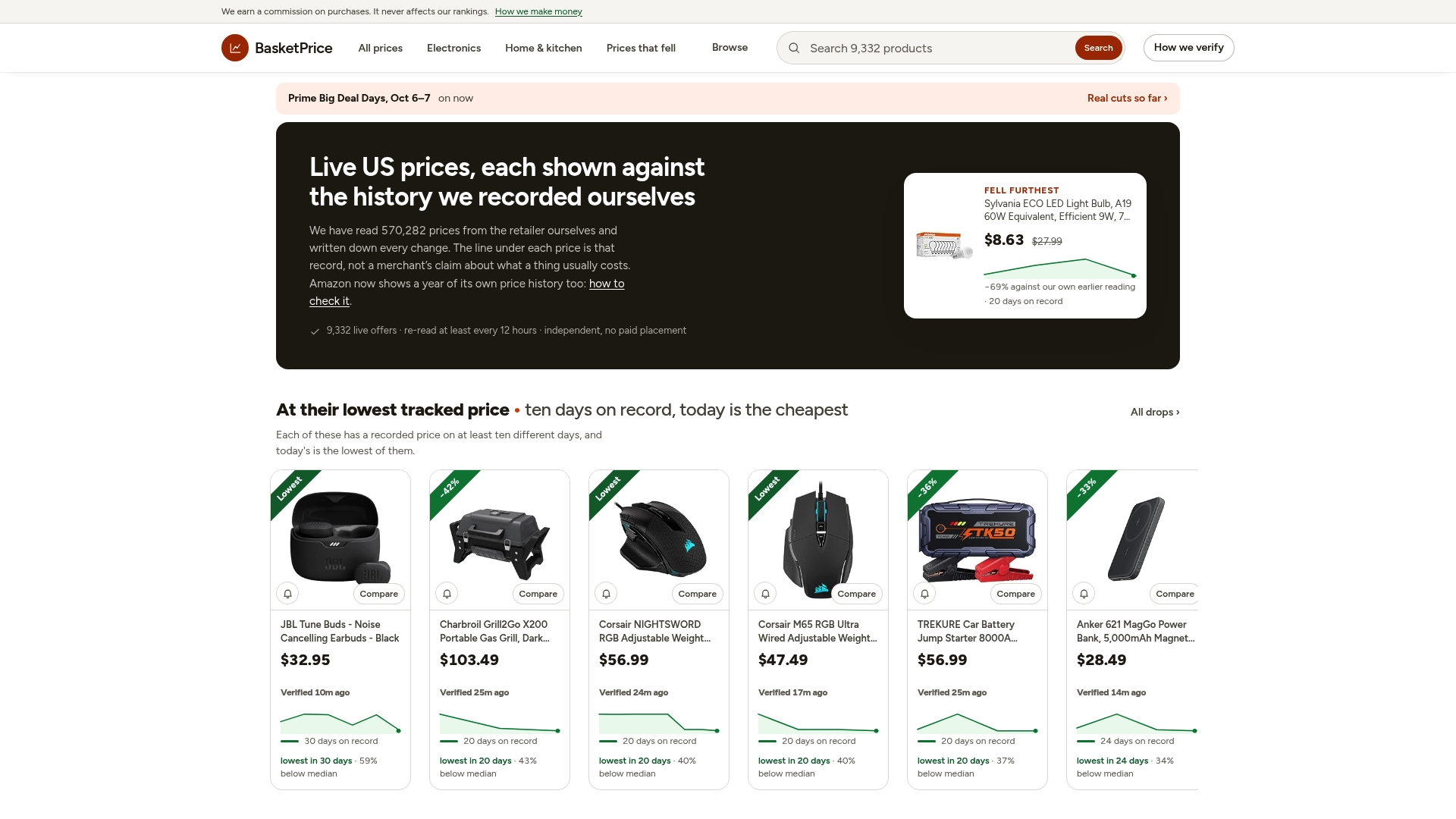
Set a drop alert on the item you want, then decide with the history in front of you. Our categories include car, electronics, home, and sports and outdoors.
FAQ
What is the Amazon preorder price guarantee?
It is Amazon's promise that, on qualifying not-yet-released items sold by Amazon.com, you pay the lowest price offered between your order and the end of release day. For digital content, the window ends when the content is released. It only applies to items that display the guarantee message.
Does Amazon charge you right away for a preorder?
Generally no. Amazon's Conditions of Use say it does not generally charge a credit card until the order enters the shipping process, or until a digital product becomes available. You may see a temporary authorization when you order, but the actual charge comes around shipment.
Do I have to claim the lower price myself?
No. Amazon's promotion terms say the adjustment is automatic. The order summary reflects the lowest price within 24 to 48 hours of a change before shipment, and any remaining difference is refunded typically within 24 to 48 hours after release. If it doesn't appear, contact Amazon customer service with your order number.
Is it cheaper to preorder?
On an item with the guarantee, you won't pay more than the lowest price in the window, so preordering carries little price risk. It doesn't capture discounts that arrive after release. If you can wait, price history shows how similar items have moved after launch.
Does the guarantee cover third-party sellers?
No. It covers items sold by Amazon.com, and lower prices that require joining a program don't count. Check the seller on the product page and look for the guarantee message before you order.
Sources
- About the Pre-Order Price Guarantee, Amazon Customer Service
- Conditions of Use, Amazon Customer Service
- How Pre-Orders Work on Amazon, Business Insider
- Promotion Terms, Amazon
- Pricing and Price Matching, Amazon Customer Service
- Shopping Cart Prices, Amazon Customer Service
- Shipping FAQ, Silver Sydney
- Price Match Policy, Safes and Security Solutions