

The best time to buy an iPad is usually Black Friday, with the October Prime sale a close second and the weeks after a new model launches as a quiet third. The worst time is the stretch just before Apple refreshes the model you want. Below, you'll find the calendar, the reasoning behind it, and how to tell a real discount from a banner that merely says "sale."
TL;DR
- Black Friday is the strongest window. In 2025 every current iPad model hit its lowest-ever price during Black Friday sales, with discounts of up to $150.
- Amazon's October sale can be nearly as good, and the summer Prime sale in June or July is the other big chance.
- Avoid buying right before a refresh. Full price for hardware that is about to be replaced is the classic mistake.
- Apple raised iPad prices in June 2026, so compare today's deals against the new baseline, not old memories of what an iPad "should" cost.
- Check recorded price history before you click buy, and set an alert if the price is not yet low enough.
Table of Contents
- The short answer by situation
- How Apple's release cycle sets the price
- What the 2026 calendar looks like right now
- The best sale events for iPads, ranked
- Other ways to pay less
- How to tell a real iPad deal from a fake one
- Our perspective
- Let us watch the price for you
- Should you buy now or wait?
- Which model should you be watching?
- FAQ
- Sources
The short answer by situation
Most people reading this want a decision, not a lecture, so here is the decision first.
| Your situation | What to do |
|---|---|
| Your current iPad no longer gets software updates, is slow, or the battery is failing | Buy now or at the next sale event; waiting costs you more in frustration than it saves |
| You want an iPad Air or iPad Pro | Wait for a sale; these models are not expected to be replaced until 2027 |
| You want the entry-level iPad or iPad mini | Wait a bit; both may be updated before the end of 2026, which would push down prices on the old ones |
| You are a student or a parent of one | Look at Apple's Back to School promotion in summer |
| It's January through April | Be patient unless you need it; this is the thinnest stretch for discounts |
The rest of this guide explains why, so you can adapt the advice if your situation does not fit neatly in a row.
How Apple's release cycle sets the price
Apple rarely discounts its own iPads. According to Reader's Digest, Apple itself seldom marks them down, and savings usually come from authorized retailers that offer discounts or gift cards. That means your timing depends mostly on two things: when the model is replaced, and when big retailers decide to compete.
The pattern in recent years has been roughly this: the standard iPad and iPad Air tend to update in spring or in the fall, while the iPad Pro tends to update in the fall, around October or November. These are patterns rather than promises, and Apple does not announce them in advance. What matters is the effect:
- Before a refresh: the current model sits at full price. Retailers have little reason to cut, and you risk paying full price for something about to be superseded.
- At the refresh: the new model arrives at a price at or near the old one. Apple's March 2026 iPad Air with M4 is a good example: it launched at $599 for the 11-inch and $799 for the 13-inch, keeping the starting price of the previous generation despite the performance gains.
- A few weeks after: retailers begin clearing old-generation stock. Reporting from The Mac Observer suggests price stability usually lasts about 60 to 90 days after a launch before the first retail discounts appear.
- Following year: if a model skips an update, the previous generation can be especially attractive the next year, when the eventual replacement triggers markdowns, and refurbished and used stock becomes more plentiful.
The practical rule: a one-generation-old iPad on sale is often a better value than the newest model at full price, because the daily experience between neighboring generations is usually small for browsing, streaming, reading and note-taking.
Why "just before a release" is the worst moment
The weeks before a likely refresh, for example late winter ahead of a spring launch or late summer ahead of a fall one, are the riskiest. You pay the full price and then watch the model become last year's. If you must buy in those windows, buy a model that is not due for an update, or use a retailer with a generous return window and keep an eye on announcements.
What the 2026 calendar looks like right now
It is late October 2026, and the situation is more specific than the general pattern. Per Macworld's October 2026 buying advice, the iPad Air with M4 and the iPad Pro with M5 are not expected to be replaced until 2027, while the mini and the entry-level iPad may be updated before the end of 2026.
That splits readers into two camps:
- iPad Air or iPad Pro shoppers have nothing to wait for on the hardware side. The only reason to wait is a sale, and the next big one is Black Friday.
- Entry-level iPad or iPad mini shoppers face a real gamble. If a refresh lands, the outgoing model usually gets cheaper, but that is a prediction, not a fact. If you need one now, a sale price on the current model is a safe purchase. If you can wait, the weeks after a launch often bring discounts on the older stock.
There is also the pricing backdrop. In June 2026, Apple raised prices by $100 to $300 across its iPad and Mac lineup, which makes historical comparisons trickier. Some retailers kept selling inventory at pre-hike prices for a limited time, as The Verge reported around Prime Day. That window is behind us, so a "good deal" today is measured against a higher baseline than a year ago.
The best sale events for iPads, ranked
1. Black Friday and Cyber Monday
Black Friday is the safest answer to "when should I buy?" As noted above, every current iPad model reached its lowest-ever price during Black Friday sales in 2025. Expect the Air, the entry-level model and the mini to get the most attention, since those are the volume sellers. Our Amazon Black Friday 2026 page tracks the likely dates (currently expected in the second half of November) and what prices have done at past events.
A caution: because prices have a higher baseline after the June increases, a discount of the same size now means a higher final price than the same discount would have a year ago. Judge by the actual dollar figure and the recorded low, not by the percentage on the badge.
2. Amazon's October sale
Amazon holds large Prime sales in June or July and again in October. Macworld notes that both regularly feature excellent iPad deals, and that October discounts often match or come close to Black Friday ones. If you caught the October event, good. If you missed it, there is no reason to panic: the remaining pre-holiday weeks often bring comparable pricing as other retailers respond.
3. Back to School
Apple's own Back to School promotion typically runs from July through September. It is aimed at eligible students, parents and educators, and the incentive is often a gift card or accessories rather than a cash discount, such as AirPods or an Apple Gift Card. That is excellent if you would buy those extras anyway and poor if you only want the lowest sticker price.
4. Summer sales
The June or July Prime sale, plus holiday weekends such as the Fourth of July, can bring decent iPad pricing. These tend to be less consistent than Black Friday, but they matter if you are buying in summer and don't want to wait until November. We keep a page on Fourth of July 2027 sales for when that season returns.
5. January through April
This is the dry spell. Discounts from third-party sellers in these months tend to be shallow, often just a few dollars to a few tens of dollars off the list price. If you shop here, you are buying for convenience, not for value.
Other ways to pay less
Apple's certified refurbished store. Apple sells refurbished devices that it describes as like-new, usually at a meaningful reduction from the new price, according to Reader's Digest. If you are flexible on color and model and do not need the very latest chip, this is one of the best values, and it is not tied to a sale calendar.
Previous-generation models. When a new iPad launches, older versions often get discounted at retailers. For most uses, one generation back is fine.
Retailer price matching. Big retailers watch each other. Tom's Guide observes that when Amazon or one of the big electronics chains cuts an iPad price, the other often matches it soon after. So if you see a deal at one retailer, you can often wait a day or two and see whether your preferred store follows.
Warehouse clubs and big-box stores. These can offer discounts or gift cards on iPads at certain moments. They are worth checking if you have a membership, though the deals are not guaranteed to beat an Amazon event.
How to tell a real iPad deal from a fake one
The trick with any big-ticket item is that the "was" price on a product page is whatever the merchant wants it to be. A crossed-out $429 next to a $349 price tells you nothing about what the iPad has actually sold for.
Here is a better routine:
- Look at recorded price history, not the strike-through price. See what the lowest price in the last 90 days and the last year was. Our guide to checking 90-day and 365-day lows before you buy walks through it.
- Account for the June 2026 increase. Compare against prices since the hike, not before, or you will wait for a price that may not return.
- Compare the same storage and connectivity. A Wi-Fi 128GB model and a cellular 256GB model can be the same name and very different prices.
- Check that it's new, not renewed. Refurbished and renewed listings sometimes sit next to new ones with the same title.
- Check the return window. If the price drops after you buy, a return and repurchase may be worth it. This is one reason post-purchase tracking is useful.
You can see how prices have behaved on our iPad price page and across Apple products.
Our perspective
We track prices for a living, and the pattern with iPads is stubbornly consistent: the people who overpay are rarely the ones who bought at the wrong event. They are the ones who bought without knowing what the usual price was. A 15% badge on a product that has been at that price for three months is not a deal. A modest-looking cut on a model that has never been that low is.
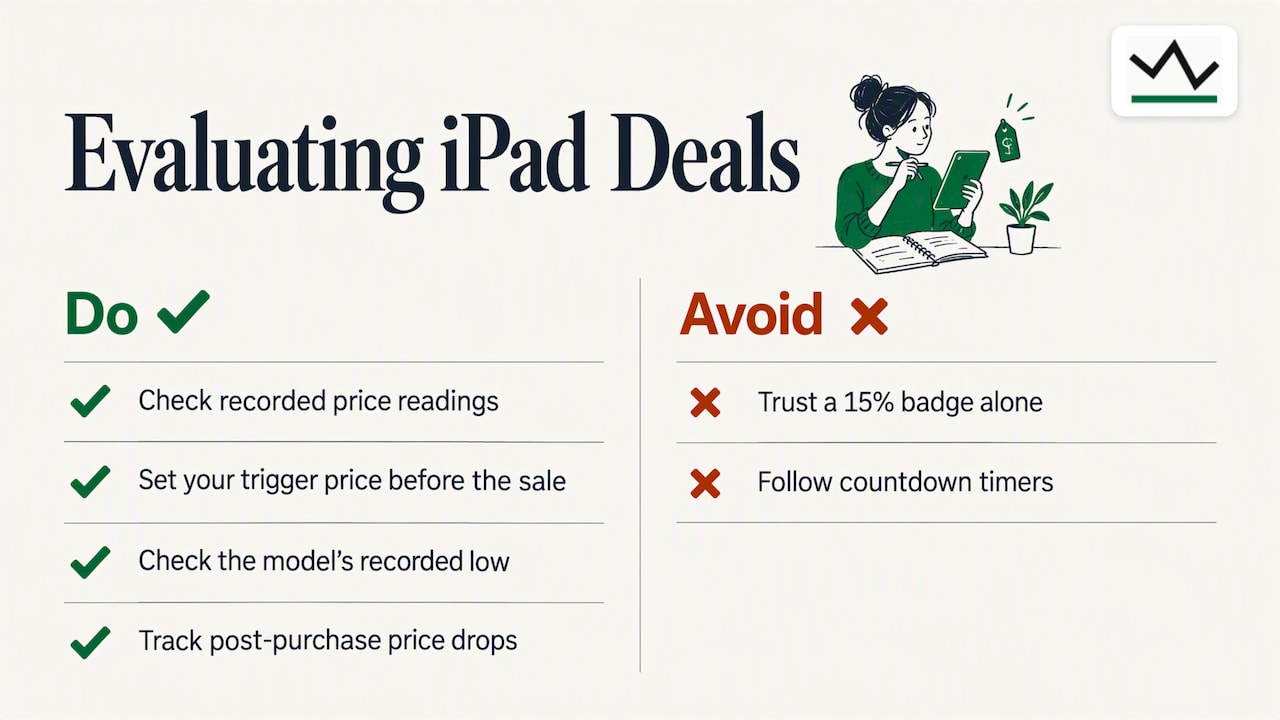
Our approach is to publish prices based on our own recorded readings, not on what a merchant says the price used to be. That matters most with Apple products, where list prices are firm and discounts are small. A $50 difference is the whole story, so you want to know whether $50 off is typical or exceptional.
The second thing we would tell a friend: decide your trigger price before the sale starts. Pick the model, check the recorded low, and decide what you'd pay. When Black Friday arrives, you are not swept along by countdown timers. And if you buy and the price falls within the return window, you should know about that too, which is why our alerts can flag post-purchase drops.
— Cleaning
Let us watch the price for you
If you would rather not check iPad listings every day, we can do it. BasketPrice records prices from major online retailers, primarily Amazon, shows you the history, and can send a browser notification when a price falls or an item returns to stock, with no sign-up needed for browser alerts. Start with our electronics deals, or see our guide to the best time to buy electronics in 2026.
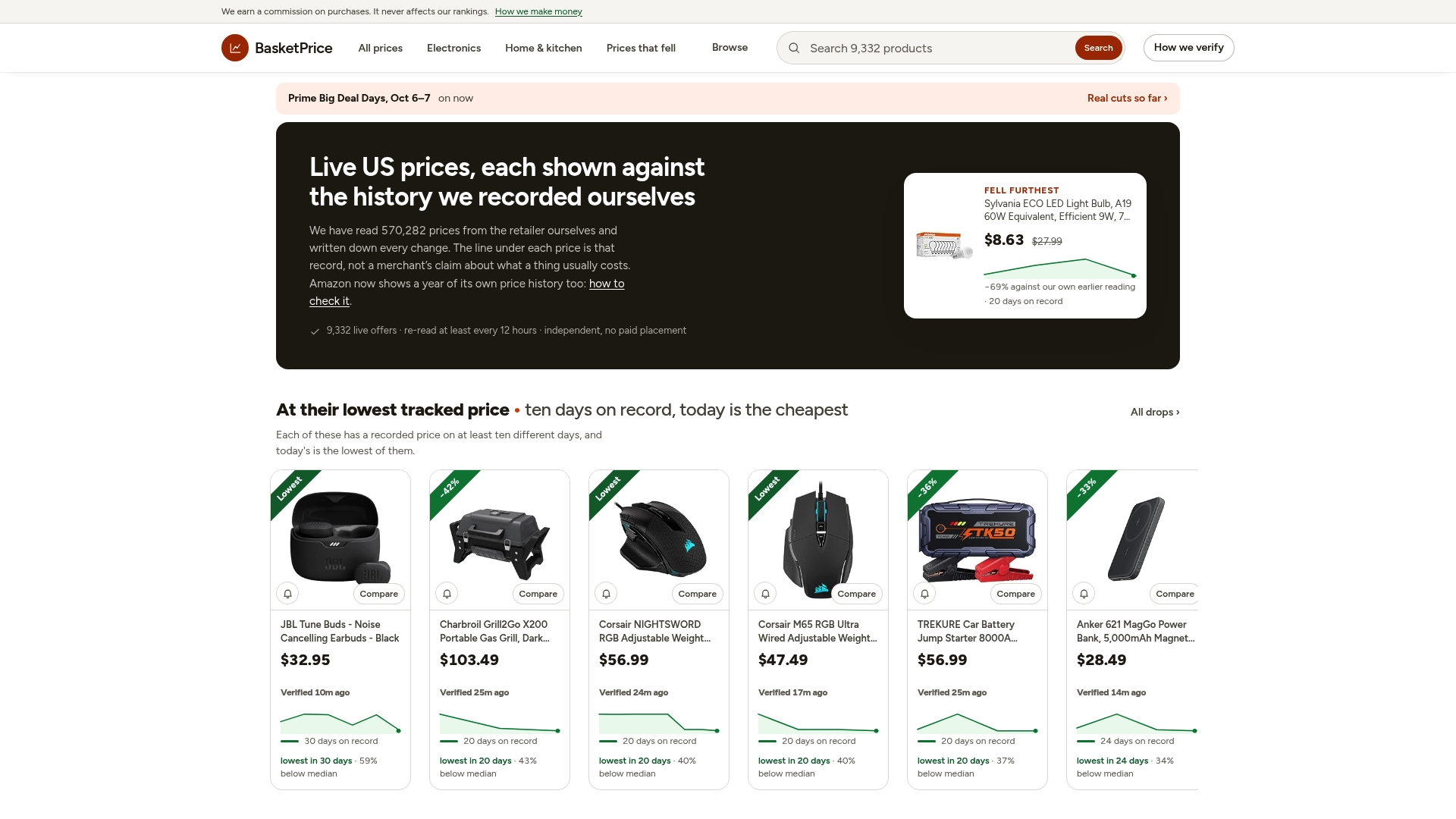
If you want to browse everything we track, start at the BasketPrice homepage.
Should you buy now or wait?
Use this quick test.
Buy now if:
- Your current iPad no longer gets software updates, runs slowly, has poor battery life, or can't run Apple Intelligence, per Macworld's guidance.
- You need it for a specific deadline, such as a school term or a work project.
- The price on your chosen model is at or near its recorded low.
Wait if:
- You are eyeing an entry-level iPad or mini and a refresh looks plausible before the end of the year.
- Black Friday is only a few weeks away and your current device still works.
- The price is only slightly below the usual price.
Do not wait forever. The cost of waiting is real: you go without a device, and prices can rise, as they did in June 2026. A reasonable approach is to set a deadline and a target price, then buy at whichever comes first.
Which model should you be watching?
Timing matters less if you are tracking the wrong model. A quick guide:
- Entry-level iPad: the budget pick for reading, video, kids and light schoolwork. Its refresh timing is the least certain right now.
- iPad mini: portable and pocketable, with a similar uncertainty about an update.
- iPad Air: the all-around choice. The M4 version launched in March 2026 at $599 for the 11-inch and $799 for the 13-inch, and a replacement is not expected until 2027.
- iPad Pro: the premium option, with the M5 model not expected to be replaced until 2027.
For the Air and Pro, the question is only when the best discount arrives. For the mini and entry-level models, the question is also whether a new version is on the way.
FAQ
What month is the cheapest to buy an iPad?
November, because of Black Friday and Cyber Monday. In 2025, every current iPad model hit its lowest-ever price then, with savings of up to $150. October can come close thanks to Amazon's fall sale.
Is it better to buy an iPad now or wait for Black Friday?
If your current iPad still works, waiting for Black Friday is usually smart, especially for the Air and Pro. If your device is outdated, slow or no longer updating, the convenience of buying now may be worth more than the likely savings.
Does Apple ever discount iPads?
Rarely. Most discounts come from authorized retailers, which may cut prices or add gift cards. Apple's certified refurbished store is the main route to a lower price directly from Apple, and its Back to School promotion usually adds gift cards or accessories rather than a cash discount.
When is the worst time to buy an iPad?
Just before an expected refresh. You pay full price for a model that is about to be replaced. The January to April stretch is also weak for discounts unless a new model has just launched.
Is the best time to buy a tablet the same as for an iPad?
Broadly, yes. Major sale events in November and the summer and fall Prime sales matter for most tablets, and launch cycles shape pricing for every brand. The difference is that Apple's pricing is firmer, so each discount stands out more and the history matters more.
Sources
- Macworld: Should I buy an iPad now or wait?
- Apple Newsroom: the new iPad Air powered by M4
- The Mac Observer: the best time to buy Apple tech
- Reader's Digest: the best time to buy an iPad
- Wirecutter: Apple's price increases
- The Verge: iPad deals before Apple's price hikes
- Tom's Guide: iPad deals