

The best time to buy a mattress is a major holiday weekend: Presidents Day in February, Memorial Day in May, Labor Day in September, or Black Friday and Cyber Monday in November. It's close to October 20 as you read this, so Black Friday is the next big window, about five weeks out. If your current bed is hurting you, though, don't wait for any of them.
The calendar matters because mattress pricing works differently from most products. Almost every mattress is advertised as "on sale" all year, so the sticker price tells you very little. What changes through the year is how much of the market drops at once, and how deep the extra discount goes. This guide shows you the windows, what each is good for, and how to confirm the price in front of you is a real low.
TL;DR
- Big holiday weekends (Presidents Day, Memorial Day, Labor Day, Black Friday and Cyber Monday) are the most dependable times to save, because a large share of brands discount together.
- Holiday prices typically beat the regular "sale" price by roughly 5 to 10 percent, which on a premium bed can mean hundreds of dollars.
- Floor-model clearance in March and April is the best non-holiday window, if you accept a mattress others have tried.
- A discount banner is not proof of a low price. Check the product's own price history before you pay.
- If you're sleeping badly or in pain, buy now and use the trial period and price guarantee instead of waiting.
Table of Contents
- Why mattress prices behave differently
- The calendar: when mattress deals tend to land
- Is the holiday discount really worth waiting for?
- When to ignore the calendar
- How to tell a real mattress deal from sale noise
- Price is not quality
- Our perspective: timing is a price question, so measure it
- Set up your bed, and the room, once you've bought
- Let an alert do the waiting
- A simple plan by situation
- FAQ
- Sources
Why mattress prices behave differently
Consumer Reports points out that most mattresses are advertised as on sale all year, which means they rarely sell at full price. That has a practical consequence: a "50% off" tag often compares the price to a list price almost nobody pays.
The useful question is not "is this on sale?" but "is this lower than this exact bed usually sells for?" Holiday events help because they stack an additional markdown on top of the everyday sale. Consumer Reports describes top manufacturers observing major and minor holidays with special offers, so you rarely wait long for a drop.
NerdWallet adds the other half of the logic: on big holiday weekends a much larger part of the marketplace is discounted at the same time, which makes comparing models quicker and fairer. You aren't hunting for one lucky markdown. You're looking at the whole field marked down together.
The calendar: when mattress deals tend to land
Different guides name different "best" months, and that's not a contradiction. Several windows are good. Here is how they compare.
| Window | Typical timing | What it's good for | Watch out for |
|---|---|---|---|
| Presidents Day | February | Broad discounts across many brands | Some sales are modest compared with fall |
| March and April clearance | Spring | Floor models and outgoing inventory | Display beds have been used by other shoppers |
| Memorial Day | Late May | Summer-opening sales with strong prices | Sizes and models can sell out |
| Fourth of July and Prime Day | Summer | Online-only offers, accessories | Not every Prime Day price is a low |
| Labor Day | Early September | One of the most widely recommended windows | Sales often start the weekend before |
| Black Friday and Cyber Monday | Late November | Deepest bundles, year-end inventory clearing | Hype and fake "was" prices |
Presidents Day (February)
Consumer Reports lists mattresses among its products on deep discount in February, and NerdWallet puts Presidents Day near the top of its list alongside Labor Day. If you're shopping in winter, this is your anchor date. You can check how the event usually looks on our Presidents Day 2027 page.
March and April: floor-model clearance
Retailers often clear floor models and older inventory in March and April to make room for new arrivals, according to NerdWallet. It's a decent time to negotiate in a showroom. The trade-off is plain: that mattress has been lain on by strangers. If you're comfortable with that, and the warranty still applies, the discount can be real.
Memorial Day (May)
Wirecutter describes Memorial Day and Labor Day as the informal bookends of summer for mattress sales. It's a good pick when you want a deal without waiting for fall. Our Memorial Day 2027 page shows what to expect for next year.
Summer: Fourth of July and Prime Day
Online deal days sit in the middle of the year. NerdWallet lists Prime Day, Black Friday and Cyber Monday as online deal days worth watching, and retailers sometimes invent their own "holidays" too. Be a little skeptical, though. Consumer Reports analysts have noted that some Prime Day prices are the same as, or higher than, prices at other times. A site-wide event is not a guarantee of a low on your specific bed. See our guides to Fourth of July 2027 sales and Prime Day dates if summer is your window.
Labor Day (September)
NerdWallet names Labor Day, with Presidents Day, as the top of its list. If you missed it this year, the next realistic stops are Black Friday and Cyber Monday, then Presidents Day.
Black Friday and Cyber Monday (November)
This is the window most shoppers think of first, and for good reason. Retailers are also trying to clear inventory before the new year, so NerdWallet calls it a close second to Labor Day and Presidents Day. Consumer Reports notes that many brands then extend their Black Friday mattress sales, and the prices are often still among the lowest of the year when they do. That means you don't have to panic on the first morning. For Amazon timing this year, see our Amazon Black Friday 2026 page, which tracks the likely window of November 19 to 30.
Is the holiday discount really worth waiting for?
Usually, yes, but be realistic about the size. Consumer Reports says holiday offers typically take an extra 5 to 10 percent off the standard year-round sale price. On a $400 bed that's $20 to $40. On a $2,500 premium model it's $125 to $250, which is meaningful.
That gives you a simple rule of thumb:
- Budget bed, urgent need: the savings from waiting are small. Buy when you need it.
- Premium bed, no urgency: waiting for the next holiday weekend can pay for your pillows, sheets and a protector.
- Mid-range bed: compare. If the next big event is under a month away, waiting is easy. If it's five months away, it may not be worth sleeping badly in the meantime.
When to ignore the calendar
The most useful advice in the research is also the least glamorous. Tuft & Needle's own buying guide says the best time to buy a mattress is when you need one. If you have pain you've discussed with your doctor and ruled other causes out, a new bed may be part of the answer, and waiting for a sale isn't the priority.
NerdWallet gives the same advice: if you can't wait, lean on a price guarantee. In practice that means:
- Buy from a seller with a real sleep trial, and read the return terms before checkout.
- Ask whether there is a price-adjustment or price-match window after purchase.
- Keep the receipt and the listing page, so you can show what you paid.
- If a bigger sale starts inside that window, ask for the difference.
If your mattress is also past its prime, that's a sign to act. A 2023 Better Sleep Council report, as cited by NerdWallet, found 77% of consumers replace a mattress because it has deteriorated. The usual benchmark is every 7 to 10 years, depending on material quality and how you use it.
How to tell a real mattress deal from sale noise
Since nearly every mattress is "on sale," the banner is the weakest signal on the page. Here's what to check instead.
Check the price history of the exact model
Mattresses are sold in many sizes and firmness levels, and the same product may be relisted under slightly different names. Look at the price record for the exact size you want. Our guide to checking price history with 90-day and 365-day lows walks through it. If today's price is at or near the 365-day low, you're in good shape. If it's sitting 15% above, a sale label doesn't change that.
Don't trust the "was" price
A crossed-out number is a claim by the merchant. A price record you collected yourself is evidence. That's why we publish price records from our own readings rather than merchant claims. For Amazon listings, our walkthrough on how to track Amazon prices and verify the "was" price shows the method.
Compare like with like
A mattress-in-a-box and a hybrid with a different layer count may share a name but not a spec. When you compare two beds, check the size, the thickness and what's included (pillows, protector, foundation). Our five steps to compare unit prices online apply here too: reduce each offer to the same basis, then compare.
Run the "buy now or wait" test
Before a big sale, ask whether the price has really been this low before and whether it's falling or just bouncing. Our five price history checks to spot sale noise give you a short routine for that decision.
Price is not quality
There's a common assumption that a higher price tag means a better bed. Consumer Reports' coverage suggests price is often a product of timing and brand positioning, and that recommended models can perform well for far less, especially when bought in the right sales cycle. So don't pick by price alone. Start with what you need: support, cooling, motion isolation, your sleeping position. Then use timing to lower the cost of the bed that fits.
Our perspective: timing is a price question, so measure it
We track prices; we don't sell mattresses. That gives us a particular view of this topic.
Most mattress advice online is a calendar, and the calendar is a good starting point. But a calendar tells you when discounts are likely, not whether the discount on your bed is real. Two things go wrong in practice. A shopper waits for Black Friday and finds the bed at the same price as in August. Or a shopper sees "40% off" and buys at a price the product has regularly sold for.
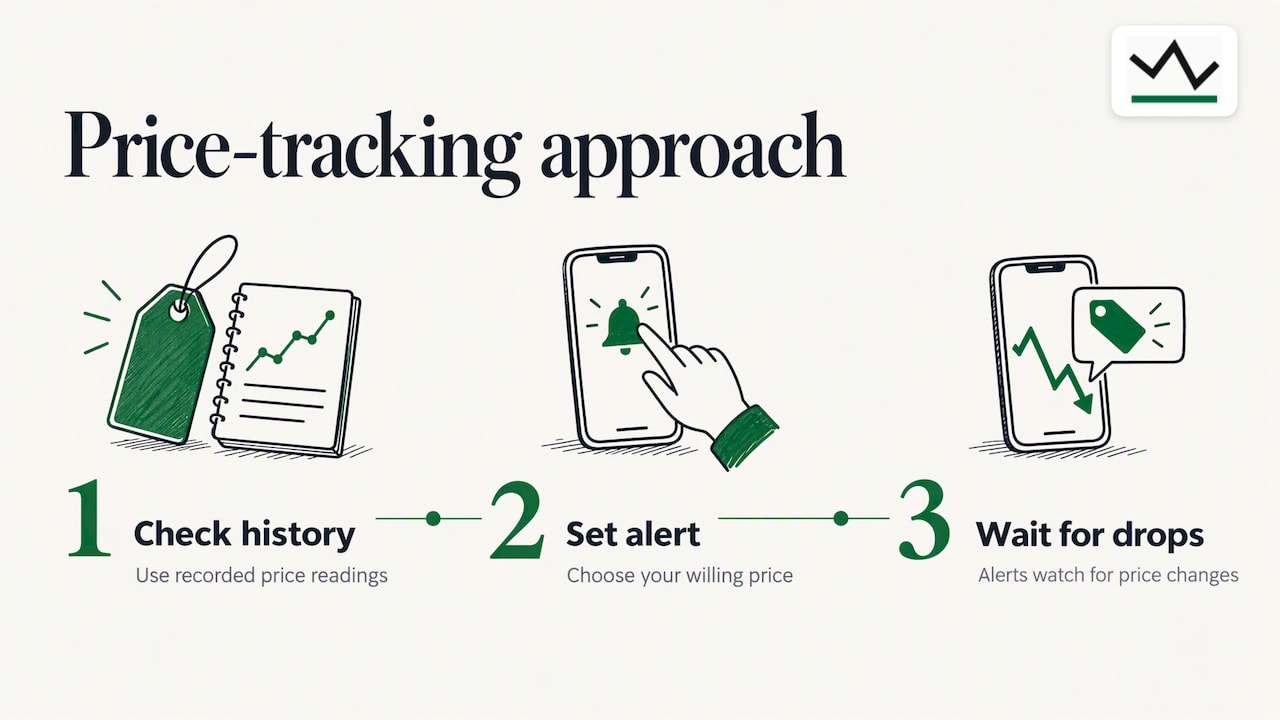
Our approach is to rely on our own recorded readings rather than merchant claims. For anything you can track on Amazon, that means looking at the history first, setting an alert at the price you're willing to pay, and letting the alert do the waiting. Our browser notifications need no sign-up, and some alerts watch for a drop after purchase, within the return window. That second one matters for big-ticket items like beds, where the sale you missed by a week can still be worth acting on.
One caution from experience: the calendar and the price record sometimes disagree. When they do, trust the record, and trust your back over both.
— Cleaning
Set up your bed, and the room, once you've bought
Buying at the right time only helps if the rest of the setup works. A new mattress changes the height of your bed, which changes how the nightstand sits next to it. This guide on measuring bedside table height and staying within 2 inches is a practical check before you order a new bed or table. Measure the top of the mattress first, with the new thickness in mind.
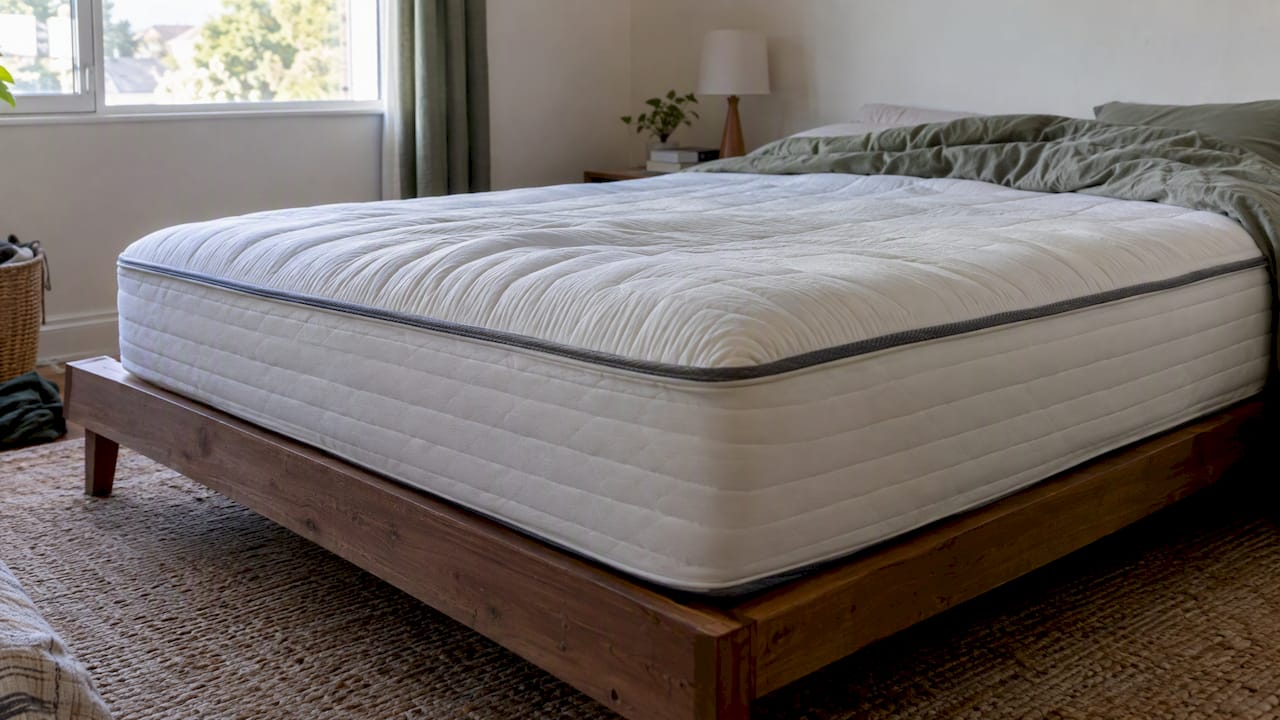
Also allow time for a vacuum-packed bed to open up. Some manufacturers recommend 24 to 48 hours for full expansion before the foam or coils reach their intended support. If it feels off on night one, check the maker's instructions before you judge it.
Let an alert do the waiting
If you're shopping for sleep accessories, bedding or other home items around the same sale, we can watch them for you. Browse Home deals and price history on BasketPrice, pick the products you want, and get a notification when the price drops or the item is back in stock. You can also see which prices really fell on our Amazon discount finder.
A simple plan by situation
- Bed hurts now: buy now with a trial and price guarantee. Check the history so you know what you paid relative to the usual price.
- Shopping in October: plan for Black Friday and Cyber Monday. Pick two or three candidates, record today's prices, and compare.
- Shopping in January to February: target Presidents Day.
- Shopping in spring: try floor-model clearance in March and April, or aim for Memorial Day.
- Shopping in summer: Fourth of July and Labor Day are both useful, but verify any Prime Day price against its history.
FAQ
What is the cheapest month to buy a mattress?
There isn't one single cheapest month, because sources differ and prices vary by brand. The most dependable low points come around holiday weekends: February, May, September and November. For a specific bed, the cheapest moment is the one your price history shows as its low.
Is Black Friday the best time to buy a mattress?
It's one of the best, not always the best. NerdWallet ranks Labor Day and Presidents Day at the top and Black Friday and Cyber Monday close behind. Black Friday's advantage is deep bundles and year-end clearing, and many sales run past the weekend itself.
Can I sleep on a new mattress right away?
Generally yes. Some manufacturers suggest allowing 24 to 48 hours for a compressed mattress to expand fully, so read the instructions that came with yours. If it hasn't expanded after that, contact the seller.
How long should a mattress last before I replace it?
The usual benchmark is 7 to 10 years, depending on the materials and how heavily it's used. Sagging, lasting pain or poor sleep are better signals than the age alone. If you have persistent pain, speak to your doctor before assuming the bed is the cause.
Should I wait for a sale if I need a mattress now?
Not if the bed is hurting your sleep or your body. Buy with a sleep trial and a price guarantee, keep your receipt, and ask for a price adjustment if a bigger sale begins during the window. The savings from waiting are typically a modest percentage, while poor sleep costs you every night.
Sources
- NerdWallet: When Is the Best Time to Buy a Mattress?
- Consumer Reports: Best Mattress Sales Right Now
- Consumer Reports: 8 Products on Deep Discount in February
- Consumer Reports: Best Holiday Deals on Mattresses
- Consumer Reports: Best Prime Day Deals on Pillows, Sheets and Other Sleep Essentials
- Wirecutter: Why You Should Never Pay Full Price for a Mattress
- Tuft & Needle: When is the best time to buy a mattress?
- PubMed Central: Effect of an Inflatable Air Mattress with Variable Rigidity on Sleep Quality