

The best time to buy a vacuum is usually between September and January, with Black Friday and Cyber Monday as the headline events, and spring as the quiet second window. But the calendar only gets you into the right neighborhood. The model you want can hit its lowest price on an ordinary Thursday in March, and a "sale" in November can be no better than what you could have paid in August. This guide gives you the seasonal pattern, the robot vacuum twist, and a way to check any deal against real price history.
TL;DR
- The broadest window for vacuum discounts runs from September through January, as makers clear older stock before new models arrive.
- Spring (around May), Memorial Day and Labor Day are solid secondary windows, and deals show up year-round for specific models.
- Robot vacuums follow the holiday calendar most closely: Prime events in October and July, then Black Friday and Cyber Monday.
- Prices can be nudged up just before a sale, so compare the "deal" to the recorded price history, not to the crossed-out list price.
- Set a price alert on the exact model and buy when it reaches its historical low, whatever the month.
Table of Contents
- The short answer: a calendar you can use
- Why prices fall when they do
- Month by month
- Robot vacuums: a slightly different calendar
- Should you wait for Black Friday?
- How to tell a real deal from a fake one
- Perspective: why we trust recorded prices over sale labels
- Put a price alert on the vacuum you want
- Choosing the right type before the right month
- A simple buying plan for the next 12 months
- Common mistakes
- FAQ
- Sources
The short answer: a calendar you can use
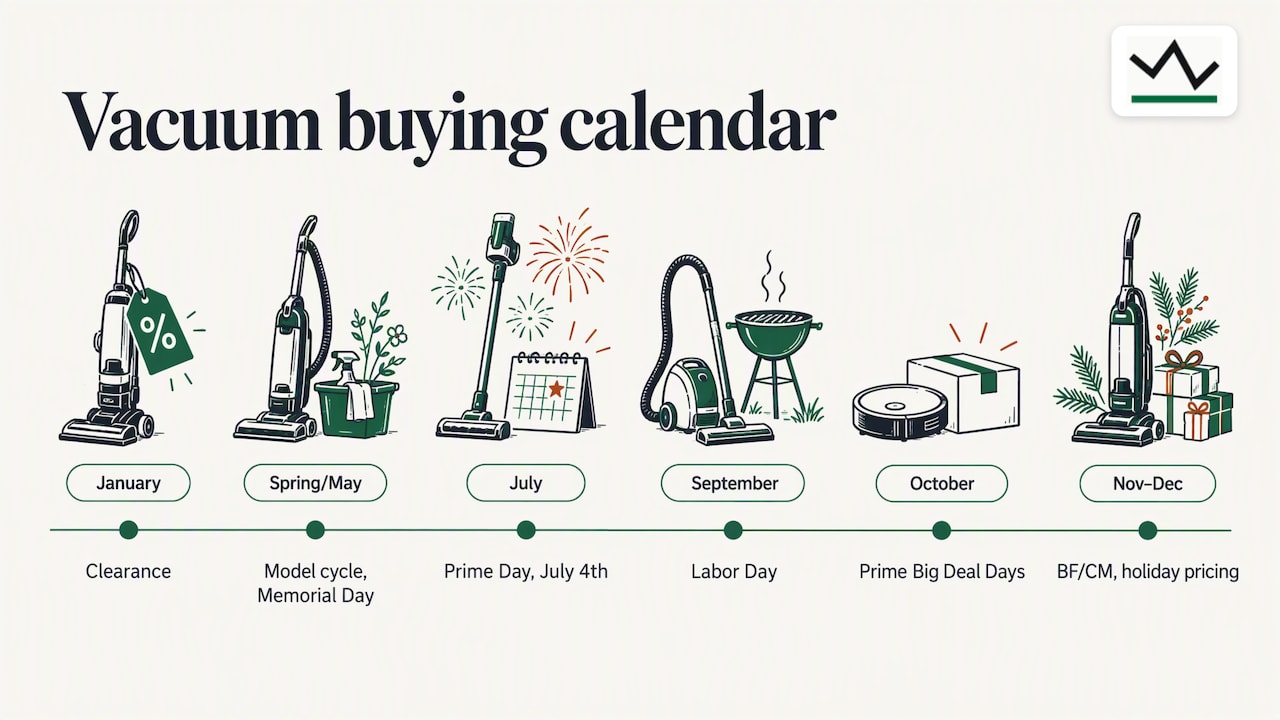
Shopping editors in the U.S. often point to the stretch from September to January as the best timeframe for widespread vacuum deals, because manufacturers clear old stock to make room for new launches. Within that stretch and outside it, these are the moments worth knowing:
| Window | What happens | Best for |
|---|---|---|
| January | Stores and brands cut prices after Christmas and New Year to clear stock | Upright, canister and stick vacuums |
| Spring (March to May) | Retailers schedule sales around spring cleaning; older models get marked down as new ones launch | Last season's premium models |
| Memorial Day (late May) | Seasonal vacuum promotions | Uprights, cordless sticks |
| Prime Day (typically July) | Large online event with deep robot vacuum cuts | Robot vacuums, cordless sticks |
| Labor Day (early September) | Sales, including on brands' own sites | Brand-direct purchases |
| October Prime event | A second Amazon sales moment before the holidays | Robot and cordless models |
| Black Friday and Cyber Monday (November) | Peak holiday promotions across all types | Almost everything |
No single month wins for every vacuum. The pattern is that new models cluster in spring and holiday events cluster in the fall, so you get two natural markdown cycles each year.
Why prices fall when they do
Two forces drive most vacuum discounts: product cycles and retail events.
Product cycles. One industry source notes that new vacuum models are typically released in spring, which leaves last season's high-end models at more reasonable prices. The Spruce makes the same point: spring is a good time to buy on sale because retailers schedule promotions around spring cleaning and mark down older picks around newer releases.
Retail events. Big shopping holidays pull brands and retailers into price competition. Miele floorcare expert Laurie Bilson names January, May and November as three of the best windows to get value from a vacuum purchase. That lines up with the post-holiday clearance, the spring cycle and Black Friday.
There is also a quieter third force: ordinary retail churn. Wirecutter's deal coverage stresses that deals can be found year-round if you watch authorized retailer sites and newsletters, especially for a specific model that dips outside the holiday windows. If you have a single model in mind, the calendar matters less than watching that one product.
Month by month
January: the clearance window
Once Black Friday is over, retailers return products to normal pricing, but some stores and manufacturers also reduce prices after Christmas and New Year to clear old stock. January is a good month if you missed the November rush or if you want an upright or canister model, which tend to be less of a focus for flashy sales.
Spring: older flagships get cheaper
If you do not need the newest generation, spring is when last year's flagship becomes the value buy. A vacuum that was a premium pick twelve months ago is often the same machine with a lower tag. Spring is also when people think about deep cleaning, which is a nice moment to pair a new vacuum with seasonal carpet cleaning maintenance so the whole floor routine gets a reset.
Memorial Day and Labor Day
Both holidays bring vacuum promotions, and the discounts can be impressive. Labor Day is a particularly good time to check brands' own websites, since manufacturers sometimes run their best direct offers then. The same source notes that vacuum bargains also exist outside Black Friday and Prime Day, so these holidays are a floor of opportunity, not a ceiling.
Summer: Prime Day and the Fourth of July
Prime Day usually lands in July and is one of the largest online shopping events of the year, and robot vacuum sales are a common highlight. Competing retailers often respond with their own sales. If you track products around that time, our Fourth of July sales page is the place to see how prices behave around the holiday.
Fall: the big run-up
Amazon's October event is now a real part of the vacuum calendar. This October, Prime Big Deal Days brought discounts upward of 40% on upright and cordless stick vacuums, with some of the steepest cuts on robot vacuums. Early Black Friday promotions follow within days, so the fall is less one event than a three-month stretch of rolling offers.
November and December
Black Friday and Cyber Monday remain the center of gravity. Cyber Monday in particular has been described as often the best moment for a strong upright at a steep discount. In December, expect lingering holiday pricing before January clearance picks up.
Robot vacuums: a slightly different calendar
Robot vacuums are electronics first and floor care second, so they follow the electronics sale calendar. Retailers cut prices aggressively on them during Prime events and the November sales, and the discounts can be large. One recent roundup of robot vacuum deals from Shark, Dyson and Eufy listed savings of as much as $450 off.
A few practical points:
- Skip the in-between months. One long-running robot vacuum buying guide advises that September is not a great time and that you should wait for holiday sales to arrive.
- Look at the first week of the month and Thursdays. The same guide notes that online deals often coincide with the first week of the month, and that Thursdays are a particularly common day for them to appear. Treat that as a tie-breaker, not a rule.
- Budget for consumables. Brushes, filters and bags are not discounted at the same rate. A deep cut on the robot can be partly offset by accessories bought at full price.
- Check model generations. A robot with a newly launched successor is the one most likely to be marked down. If you are weighing a model such as the iRobot Roomba Max 715, its price history shows how far and how often it has actually dropped.
Should you wait for Black Friday?
For most people with a flexible deadline, yes, Black Friday and Cyber Monday are worth waiting for, especially if you want a robot vacuum or a premium cordless stick. They are the most competitive weeks of the year, and every major brand and retailer is trying to match each other.
But waiting is not automatically smart. Consider these cases:
- Your vacuum has died. Do not live with dirty floors for a few weeks to save a modest amount. Buy a sensible model now and use a post-purchase alert (more on that below) in case the price falls within the return window.
- The model is already at its lowest price. If the recorded history shows it already hit its floor in October, November may not beat it.
- Stock is thin. Popular models can sell out during peak weeks. Having a target price and an alert set means you can buy the moment it hits.
- The "sale" is not much of a sale. Shoppers are cautioned that some retailers may raise prices just before a major sale so discounts look larger than they are. A 30% discount from an inflated list price can still be a mediocre deal.
The honest answer: wait for November if you can, but decide in advance what price you would be happy with, and buy early if you see it.
How to tell a real deal from a fake one
Any sale page can show a big percentage. The question is what that percentage is measured against. Here is a short check that takes a few minutes.
- Look at the price history. Journalists who evaluate deals for a living check price trackers and include only offers that are at their lowest price in at least three months. You can apply the same standard to any vacuum.
- Compare with the typical price, not the list price. Consumer Reports weighs a vacuum's test performance, predicted reliability, owner satisfaction, features and the discount relative to its typical cost. A deep discount on a weak vacuum is still a poor purchase.
- Watch the weeks before the sale. If a price climbs the week before an event and then "drops" back, you have seen a staged discount.
- Confirm the seller. Buy from the manufacturer or an authorized retailer so that warranty and returns are not in question.
- Match the exact model number. Retailers often sell a slightly different variant under a similar name for sale events. Compare model numbers, not names.
For example, our Shark vacuum price page and the Dyson V11 Origin history show recorded prices over time, so you can see whether today's number is a floor or just a Tuesday.
Perspective: why we trust recorded prices over sale labels
We built BasketPrice around a simple idea: a discount is only a discount if you know what the price was before it. Many sale pages rely on a merchant's own "was" price. We do not. Our price records come from our own readings of retailer prices, so a vacuum's history reflects what shoppers could actually have paid.
That matters most with vacuums, where the same model can bounce between several price points in a single quarter. In our view, the best time to buy is rarely a date. It is the moment a specific product reaches the bottom of its own range. The calendar tells you when to start paying attention; the price history tells you when to click.
We also think the purchase does not have to end at checkout. Our alerts can flag a price drop after you buy, so if a vacuum falls inside the retailer's return window you can decide whether to take advantage of it. And because browser notifications work without signing up, you can set one up in a few seconds and get on with your day.
— Cleaning
Put a price alert on the vacuum you want
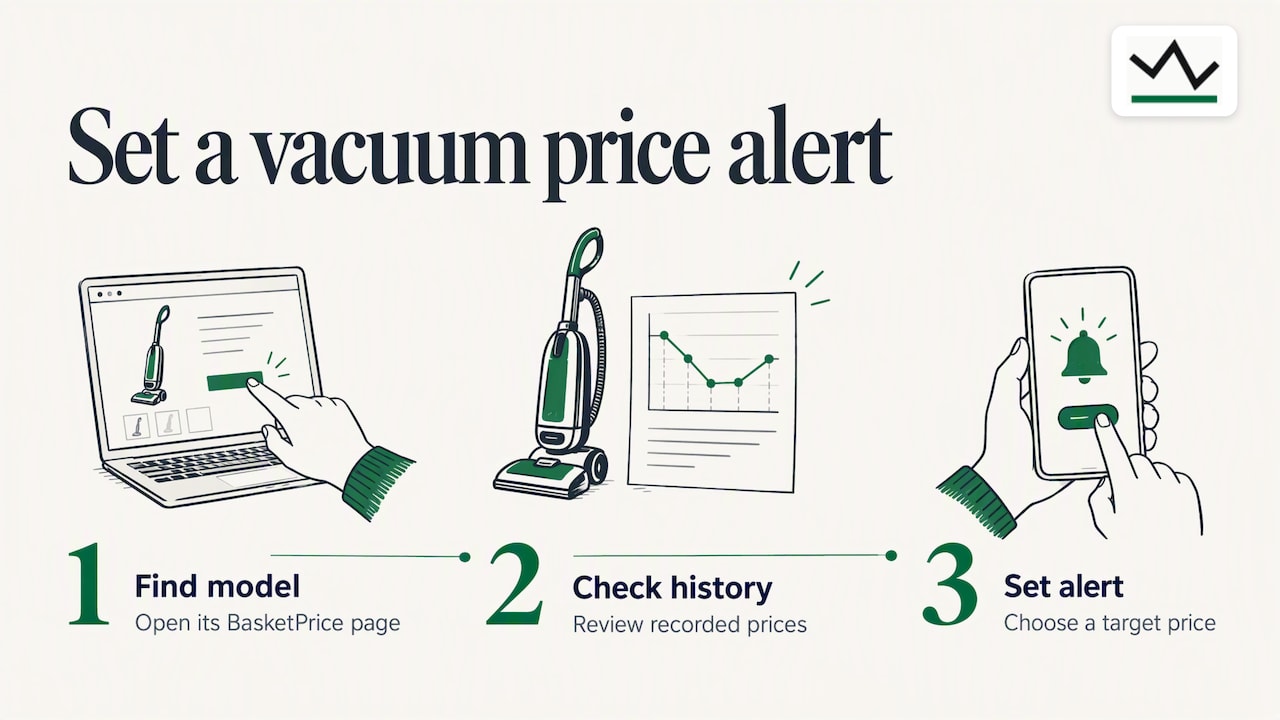
If you already know the model, you do not need to remember a calendar. Open its page on BasketPrice, look at the recorded price history, and set an alert for the price you would happily pay. You can also set alerts for back-in-stock notifications, which helps with popular robot vacuums that sell out in peak weeks. Start from our home category to find vacuums and related home products, or see how timing works for connected gadgets in our guide to the best time to buy electronics.
Choosing the right type before the right month
Timing a bad purchase perfectly still gives you a bad purchase. A few notes on matching type to need:
- Upright and canister vacuums are the long-haul option. Mid-range models can last 10 to 15 years or more with proper maintenance, so paying a little more for build quality at a discount is usually smarter than chasing the cheapest unit.
- Cordless sticks are convenient for quick cleanups and small homes. Battery life is the weak point, so look at the run time and check how replacement batteries are priced. Budget models such as the CDYJLDY cordless vacuum and the KARDV cordless vacuum are worth checking against their price history, since low-cost listings can move around often.
- Robot vacuums save the most time on hard floors and low-pile carpet. If you want mop functions too, a combo like the ROPVACNIC robot vacuum or the Lefant M210 Pro gives you a lower-cost way to compare.
- Handheld vacuums are the easiest category to buy on impulse and the easiest to overpay for. A handheld like the Black+Decker Dustbuster AdvancedClean or the cordless Dustbuster HNVC215B10 tends to be a small purchase where a price alert saves a few dollars rather than a few hundred.
A simple buying plan for the next 12 months
The table above is a map. This is a route.
- Decide your type and budget now. Write down the two or three models you would be happy with.
- Record the current price. Today's price is your baseline.
- Set alerts for each model. Choose a target price that is below the baseline and near the lowest price on record.
- Hold through the next big event. For most shoppers, that is Black Friday and Cyber Monday, or Prime Day if you are reading this in spring.
- Buy at your target, not at the headline. If a model reaches its historical low in an ordinary week, buy it.
- Keep the alert running for a few weeks after. If the price falls inside the return window, you can decide whether to return and rebuy, depending on the retailer's policy.
This approach also protects you from impulse buys. A countdown timer on a sale page is a retail tool, not a sign that the price will be higher tomorrow.
Common mistakes
- Treating the percent off as the deal. The only useful number is the final price compared with the history.
- Ignoring the model year. The same brand name can cover several generations with different battery, suction and software.
- Buying a robot vacuum in a dead month. Outside the holiday events, discounts tend to be thinner.
- Waiting too long for a single model. If the exact model keeps selling out, a close alternative at a good price beats an empty cart.
- Forgetting the return window. A purchase that looks fine today can look worse next week. Know the policy before you buy.
FAQ
What is the best month to buy a vacuum?
November is the most reliable single month because of Black Friday and Cyber Monday, with January and May as strong alternatives. Shopping editors also point to the broader September to January stretch for widespread deals. If you have one specific model in mind, its own price history will tell you more than any month.
When is the best time to buy a robot vacuum?
Robot vacuums tend to see their deepest cuts during Prime events (July and October) and Black Friday and Cyber Monday. Avoid in-between months such as September if you can wait. Check the model's price history first, because some robots reach their lowest price outside the big events.
Should I wait for Black Friday to buy a vacuum?
If you are not in a hurry and you want a robot or a premium cordless model, waiting is usually worth it. If your current vacuum has failed, or the model you want is already at its lowest recorded price, buy now. Set an alert so you can act the moment a price reaches your target.
Do vacuum prices drop after the holidays?
Yes. Some stores and manufacturers lower prices after Christmas and New Year to clear old stock, which makes January a good month for upright, canister and stick vacuums. Memorial Day and Labor Day also bring vacuum promotions.
How can I tell if a vacuum sale is real?
Compare the current price with the product's recorded price history, and look for a price at or near the lowest in at least three months. Be wary of prices that rise right before a sale. Also confirm the exact model number so you are not comparing different variants.
Sources
- Wirecutter: Black Friday cleaning deals
- The Spruce: The 7 Best Vacuums of 2026
- Homes and Gardens: How to Find the Best Vacuum Deals
- Digital Trends: The best time to buy a robot vacuum
- Top Ten Reviews: When is the best time to buy a vacuum?
- Popular Mechanics: Prime Big Deal Days vacuum sales
- NBC Select: Best robot vacuum deals
- NBC Select: October Prime Day vacuum deals
- Consumer Reports: Best deals on vacuums