

Amazon Warehouse deals are returned, open-box and lightly used items that Amazon inspects and resells at a discount, now under the name Amazon Resale. They can be a real bargain, but only if you check the condition grade, know the return rules and compare the price against what the same item normally costs new. This guide walks through all four, in the order you will use them.
TL;DR
- Amazon Warehouse is now called Amazon Resale. You find it from the Resale homepage or the "Buy Used" and "Save with Used" options on a product page.
- Read the condition grade and the listing comments before you pay. They tell you about cosmetic wear, missing accessories and packaging.
- Resale items ship from Amazon and can be returned within 30 days, but there is usually no manufacturer warranty and Amazon may not be able to send an identical replacement.
- A "discount" is only a deal if it beats the item's real price history, so check 90-day and 365-day lows first.
- For expensive electronics, film the unboxing and consider buying new from an authorized seller.
Table of Contents
- What Amazon Warehouse is today
- How to find Amazon Resale items
- Reading condition grades without guessing
- Returns, refunds and replacements
- Are Amazon Warehouse deals worth it?
- How to tell a real deal from a fake discount
- Timing: sales, stacking and Prime Day
- Perspective: why we track prices before we buy resale
- Put your target price on autopilot
- A buying checklist
- FAQ
- Sources
What Amazon Warehouse is today
Amazon Warehouse was the long-running name for the section of Amazon that sells returned, open-box, used and refurbished-looking stock. Amazon has since rebranded the program as Amazon Resale. You will still hear people say "Warehouse deals," and the idea is unchanged: an item came back to Amazon, was checked, graded and listed again at a lower price.
Two things Resale is not:
- It is not brand new stock. Even "like new" items have been owned or opened by someone else.
- It is not the same as Amazon Renewed. Renewed items are professionally refurbished and carry a Renewed Guarantee, while Resale items are returns that have not been professionally repaired. That difference matters when you think about reliability and warranty, so check which label a listing carries before you compare prices.
Because the stock is made of one-off returns, there is no catalog to browse the way you browse new products. Inventory turns over constantly, and the same model can be listed at several different grades and prices on the same afternoon.
How to find Amazon Resale items
Amazon's own guidance gives two main routes, described on its Amazon Resale page:
- Start at the Resale homepage. Browse by category, or search for the exact item you want.
- Start from a product page. Look for the "Save with Used" or "Buy Used" section. It shows used and open-box offers for that exact product, next to the new price.
The second route is usually faster when you already know what you want, because you see the new price and the Resale price side by side. The first suits browsing when you are flexible, for example looking for any decent camping stove or a monitor in a certain size range.
Search habits that work
- Search by exact model number. Product names are vague. Model numbers keep you from comparing a current model with last year's.
- Check back often. Amazon says Resale inventory changes frequently, so look again and order quickly when something fits.
- Save your searches mentally by category. If you shop for a type of product regularly, such as car electronics or smart home devices, check the same categories on the same days each week to learn typical prices.
- Expect gaps. Popular items sell out fast. Missing a listing is normal, not a sign you did something wrong.
Reading condition grades without guessing
Every Resale product goes through a quality check before it is sold, and each gets a grade describing its overall condition, according to Amazon's product conditions help page. The grade is only the headline. The details that decide whether you will be happy sit in the listing comments, where Amazon notes the item's appearance, how it functions, which accessories are included and what the packaging looks like, including missing parts.
Before you click buy, read the comments for these five things:
| What to check | Why it matters |
|---|---|
| Accessories | A charger, remote, mounting kit or cable that is missing can cost more to replace than the discount saves. |
| Cosmetic wear | Scratches on a back panel do not matter for a router. They matter a lot for a phone you will carry daily. |
| Packaging | Damaged or generic packaging is fine for personal use, and a problem for a gift. |
| Function notes | Look for any mention of tested, working condition. |
| Seller and shipper | Confirm the item ships from Amazon, which is what brings the Resale return rules into play. |
A useful rule: the more the item's value depends on small parts (cables, adapters, batteries, straps), the more carefully you read the accessory line. For a drill, the battery and charger are the product. For a tent, it is the poles and stakes.
Returns, refunds and replacements
Returns are the question most shoppers have, and the answer is reassuring with one catch. Resale products are shipped by Amazon and can be returned within 30 days of receipt of shipment. That is what makes buying a returned item less risky than buying a used one from a stranger.
The catch is replacement. Amazon cannot replace a Resale item with one in exactly the same condition, though it may have something similar in stock. In practice, if your item is defective you should expect a refund as the dependable outcome, and a replacement as a bonus.
To make a return painless:
- Test it the day it arrives. Do not leave it in the box for three weeks. The 30 days run from receipt, not from first use.
- Keep every piece of packaging and the accessories until you are sure you are keeping the item.
- Photograph defects before you start the return, in case of a dispute.
- Set a reminder for day 25 so you never discover the window has closed.
One more point most guides skip: the manufacturer warranty. As Forbes' guide to Amazon Warehouse notes, the main risks of Resale are the lack of a manufacturer warranty and the inability to swap a defective item for an exact replacement, while the fulfillment and 30-day policy keep purchases generally safe. Treat the 30-day window as your whole warranty, and use it fully.
Are Amazon Warehouse deals worth it?
Yes, when three conditions line up: the item is cheap enough that the discount matters, the grade and comments fit how you will use it, and the price really is below normal. They are a poor fit when you need a fresh warranty, a gift in pristine packaging, or a particular unit in exactly the condition of a new one.
The categories where Resale tends to make the most sense are the ones where cosmetic wear is irrelevant and function is easy to test in a day:
- Home and smart home devices: plugs, cameras, sensors and speakers either work or they do not. Our smart home price page shows that new prices in October 2026 typically ran $27 to $100, which gives you a baseline for judging a Resale listing.
- Sports and outdoors gear: camping and hiking items often show only minor scuffs. New prices on our sports and outdoors page typically ran $22 to $120 in October 2026.
- Car accessories and car electronics: dash cams, chargers and detailing tools are easy to check right away. Our car electronics page showed typical prices of $42 to $160 in October 2026.
- Consumer electronics: the savings are largest here, and so is the risk, as the next section explains. Our electronics page showed typical prices of $79 to $650 in October 2026.
If you want a wider look at what you give up and gain with returned goods in general, our piece on open box versus new goes through the trade-offs.
Extra care on expensive electronics
Return fraud is the risk to know about at the top end. One widely reported 2026 case involved an Amazon Resale graphics card delivery that contained rocks and a towel instead of the product. The practical lessons from that report: for items over $1,000, consider buying from an authorized retailer even if it costs a little more, and for any high-value item, record yourself opening the package so you have evidence if something is wrong.
That habit costs you two minutes. Start the video before you cut the tape, show the label and the box on all sides, then show the contents as you take them out.

How to tell a real deal from a fake discount
The "was" price on a listing is a reference point, not proof. A Resale price of $140 against a "list" of $250 looks like 44% off, but if the same item sold new at $150 for most of the year, you are saving very little for taking on a used unit.
A four-step check takes about five minutes:
- Find the model number in the listing.
- Look up the new price history for that model. Our guide to seeing Amazon price history before you buy shows how, and our price history check explains the 90-day and 365-day lows.
- Compare the Resale price to the typical new price, not the list price. A sensible Resale discount should be meaningfully below the usual new price, since you are giving up the warranty and a sealed box. What counts as meaningful is up to you. Many shoppers set a floor of 20 to 30 percent below the usual price, and a higher one for items where wear matters.
- Check the new price one more time on the day you buy. New prices can fall below the Resale price during a sale, which makes the used unit pointless.
Our approach, since we record prices ourselves, is to rely on observed data rather than a seller's stated "original" price. For the general method, read how to track Amazon prices, which covers checking 365 days and verifying the "was" price.
Using a worked example
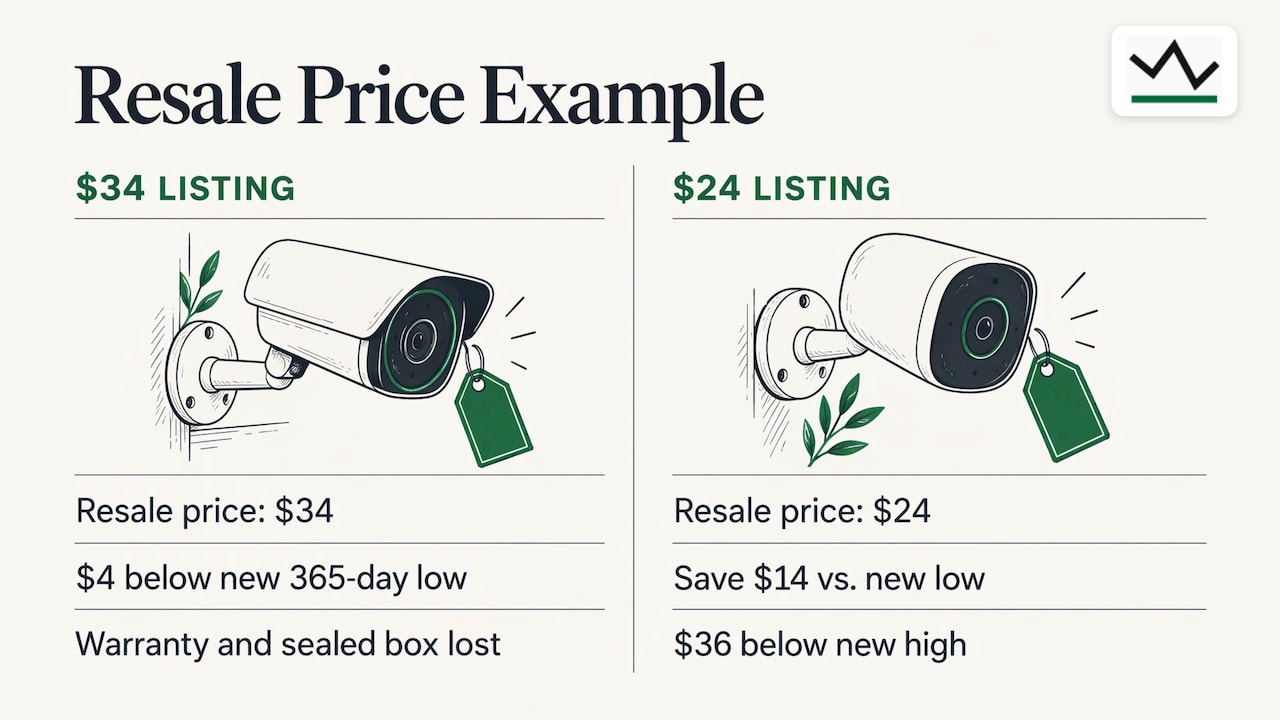
Say you want a smart security camera. The new camera has sold between $38 and $60 over the past year, with a 365-day low of $38. A Resale listing in "Very Good" condition is $34 with all accessories. That is below the best new price, but only by $4, and you give up the warranty and a sealed box. Not compelling. If the same listing were $24, the saving would be $14 against the best new price and $36 against the high end. That is where Resale earns its place. The numbers here are illustrative, but the logic is the one to apply to any listing.
Timing: sales, stacking and Prime Day
Resale discounts can combine with Amazon's broader events. Media reports on Prime Day say Amazon takes an additional 30% off many Resale items at checkout and that the Resale deals page and its search box are the quickest way to find eligible items. The same coverage suggests searching early and often, because many deals are limited. Since event terms change from year to year, read the current Prime Day or event page on Amazon for the exact rules before you plan a purchase.
Other ideas for combining savings:
- Coupons and Subscribe & Save on consumables can stack with other discounts, although only some items qualify. One shopping roundup claims combined savings of 30 to 50 percent on certain items. Treat that as a ceiling, not an expectation.
- Seasonal sales elsewhere. When you are comparing options, it helps to know how other retailers run their holiday sale collections, because a competing seasonal discount on a new item can beat a Resale price.
- Big shopping events. Our Big Spring Sale page collects what we record around that event, and new prices often dip enough to undercut Resale.
For non-event timing by category, see our guides on the best time to buy sports and outdoor gear and the best time to buy car electronics.
Perspective: why we track prices before we buy resale
Resale is a first come, first served hunt. Items are one of a kind, and the good ones disappear in hours. That makes shoppers feel rushed, and a rushed shopper overpays for a "deal" that was not one.
We built BasketPrice to take the guesswork out of that moment. We publish price records based on our own recorded readings rather than merchant claims, so you can see what an item has actually cost over time. With that, a Resale listing stops being a gamble: you know the real new-price range, you know the lowest it has been, and you can decide in a minute whether a used unit is worth the trade-off.
Our alerts are also built around the way shoppers actually buy. They include price drops and back-in-stock notices, and you get them as browser notifications with no sign-up required. We even support triggers like a price drop after purchase within a return window, which is useful if you bought new and want to know if a cheaper moment follows.
Our advice: decide your target price before you open Resale, not after you see a listing.
Cleaning
Put your target price on autopilot
The hardest part of shopping Resale is not finding listings. It is knowing the number to beat. Set that number once and let the alerts do the watching: add the item on our Amazon price tracker, choose the price you would pay, and get a browser notification when the new price drops or the item returns to stock. You can also start from our best-selling electronics or browse all our categories to see current price ranges before you decide.
To learn how the alerts verify a drop against real data, read our Amazon price alerts guide.
A buying checklist
Print it, screenshot it or keep it in your notes:
- Find the exact model number and the typical new price.
- Write down your maximum price for a used unit.
- Open the Resale listing and read the grade and the comments, especially accessories.
- Confirm the item ships from Amazon so the 30-day return applies.
- Check that the new price today is not lower than the Resale price.
- For anything over $1,000, consider an authorized retailer instead.
- Record the unboxing for high-value items.
- Test everything within the first week and set a reminder before day 30.
If your price comparison involves other stores, the same logic applies. Our guides to Walmart, Home Depot and Lowe's price history and Best Buy price history help you check whether another retailer's new price beats the Resale one. If you are weighing packs and sizes rather than conditions, our walkthrough on comparing unit prices online applies too.
FAQ
Is Amazon Warehouse the same as Amazon Resale?
Yes. Amazon rebranded Warehouse as Resale, and it sells returned, used, refurbished-style and open-box products at a discount. It is different from Amazon Renewed, whose products are professionally refurbished and come with their own guarantee.
Can I return an Amazon Warehouse item?
Yes. Resale products are shipped by Amazon and can be returned within 30 days of receipt of shipment. A replacement in exactly the same condition is not guaranteed, so a refund is the outcome to expect for a defective item.
How do I find the best Amazon Warehouse deals?
Start at the Resale homepage or the "Buy Used" section of a product page, and search by exact model number. Check often, since inventory changes quickly, and compare each listing with the item's price history before you buy.
Do Amazon Warehouse items come with a warranty?
Generally no manufacturer warranty applies, which is one of the main trade-offs of buying Resale. The 30-day return window is your protection, so test the item right away. For high-value electronics, buying new from an authorized retailer may be the better fit.
Sources
- Amazon Resale: Understanding Product Conditions
- What is Amazon Resale? (Amazon, US)
- Amazon Warehouse rebrands as Amazon Resale (Amazon, UK)
- Amazon Warehouse condition grades and return rules
- Everything You Need To Know About Shopping Amazon Warehouse (Forbes)
- Amazon Resale RTX 5090 delivery report
- The Best Prime Day Deals Are Slightly Hidden
- 12 Secret Amazon Shopping Hacks to Save Money in 2026
- Holiday sale collection