
The better deal is the one with the lower final total at checkout. Add the item price, shipping, required fees and tax, then subtract any discounts. Free shipping wins only when that number is lower. A cheaper item with shipping can win just as easily, and the answer changes from order to order. Below is the arithmetic, the traps that tip the result, and how to use price history to make the call quickly.
TL;DR
- Compare delivered totals for the same product, quantity and delivery speed, not the sticker price or the word "free."
- Total = item price + shipping + fees + tax − coupons. The lowest total wins, whichever store it comes from.
- Free-shipping minimums can push you to add items you did not plan to buy. Count the added item in your total.
- Free shipping feels better than it often is, so do the sum before you click.
- Check the item's price history first. A "free shipping" price that is above its usual price is not a deal.
Table of Contents
- The one sum that settles it
- A quick comparison table
- Why free shipping feels like the better deal
- Where free shipping really costs more
- Minimums, thresholds and the extra item trap
- Speed is part of the price
- What the checkout surprise does to shoppers
- When to take free shipping, and when to take the lower price
- Our perspective
- Use price history to judge the offer
- Track the price and buy at the right time
- FAQ
- Sources
The one sum that settles it
Stores present shipping in two ways. Some charge a lower item price and add shipping. Others raise the item price and call delivery free. Your wallet only sees the total, so that is the only number worth comparing.
A shopping-cost guide from ComparePriceDirect recommends comparing final checkout totals for the same product and quantity under the same delivery conditions. Its formula is item price + shipping + required fees + tax − discounts. A higher listed price can still produce the lower delivered price, and the reverse is also true.
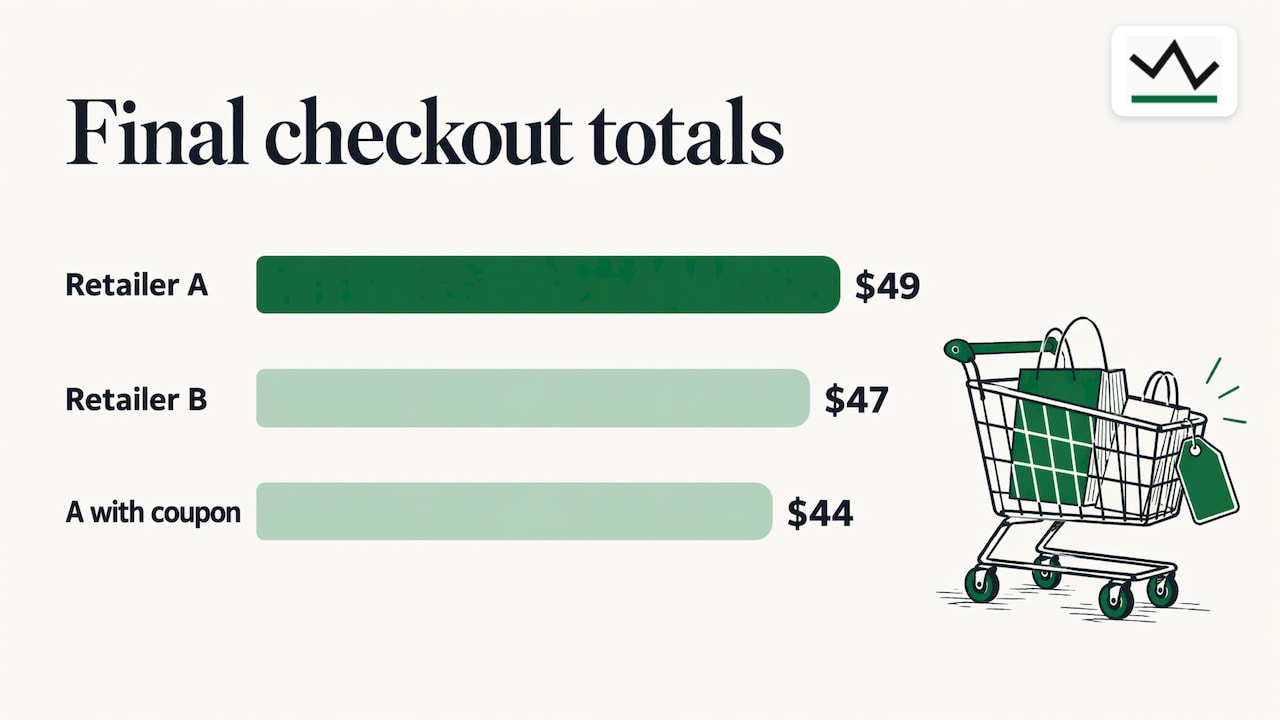
Here is a worked example from that guide. Retailer A lists a product at $42 with $7 delivery, a total of $49. Retailer B lists the same product at $47 with free standard delivery, a total of $47. B is cheaper by $2. Now suppose A offers a valid $5 coupon. Its total drops to $44 and A is the better deal. The "free shipping" label never decided anything. The arithmetic did.
A simple routine takes about a minute:
- Put the same item and quantity in the cart at each store.
- Choose the same delivery speed, standard against standard.
- Enter your ZIP code so tax and shipping are real numbers, not estimates.
- Apply any coupon you can actually use.
- Read the final total and compare.
Do not forget tax and fees
The sticker price is not the price you pay. A ConsumerAffairs piece by Kyle James gives a plain example: a $38 item with $8.99 shipping really costs $46.99 before tax. It advises comparing the all-in price across retailers rather than the advertised sale price.
Sales tax adds more. A Daily Discount Hub guide uses a $120 item with 7.5% tax and $6.99 shipping, which comes to $135.99. Tax rates vary by state and sometimes by city, so your own checkout page is the reliable source.
One more cost sits after the purchase. If you might return the item, ask who pays return shipping and whether there is a restocking fee. A total-cost guide from Invy lists both among the things to check, along with coupon validity and seller trust.
A quick comparison table
These examples are illustrations with round numbers. Use them to see how the sum behaves.
| Scenario | Option A | Option B | Cheaper |
|---|---|---|---|
| Same item, one store charges for delivery | $42 + $7 shipping = $49 | $47, free shipping = $47 | B, by $2 |
| Same as above, with a $5 coupon on A | $42 + $7 − $5 = $44 | $47 | A, by $3 |
| Free shipping needs a $35 minimum | $28 item + $6 shipping = $34 | $28 item + $9 filler item = $37, free shipping | A, by $3 |
| Higher price includes faster delivery | $30 + $8 standard = $38 | $36 with free 2-day = $36 | B, if you want it fast |
The third row is the one people miss. If you add a $9 item you did not want just to avoid $6 of shipping, you paid $3 more and got something you may not use.
Why free shipping feels like the better deal
If the numbers are often a toss-up, why does "free" win so many arguments? Because people do not weigh the two the same way.
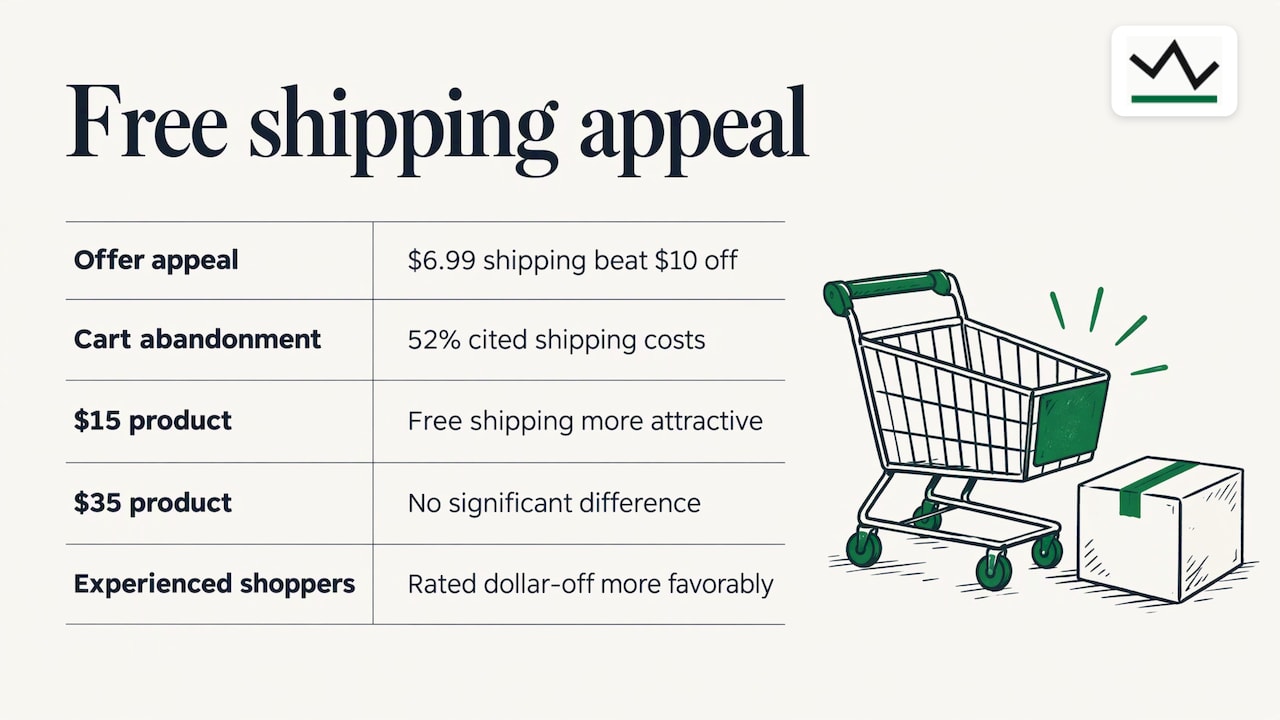
Wharton marketing professor David Bell's research found that a free shipping offer worth $6.99 appealed to shoppers more than a $10 discount on the item price. The same Wharton discussion cites a 2004 survey in which shipping and handling costs triggered 52% of online cart abandonment.
The effect depends on price level and experience. A quasi-experimental study found free shipping more attractive than a dollar-off discount for lower-priced goods, such as a $15 product. For a $35 product there was no significant difference, even when both offers were worth the same. It also found that experienced online shoppers rated dollar-off discounts more favorably than novices, because they expect to pay for shipping and do not treat it as a bigger loss.
In plain terms, the sting of a separate shipping line is real, and sellers know it. That does not make free shipping a bad choice. It means the feeling is not evidence, so check the total.
How much shoppers care
Surveys agree that free shipping matters a lot to US shoppers, though they differ on how much. A 2026 Bizrate Insights survey of 1,010 US adults found 57% prioritize free shipping over lowest price when choosing where to shop, against 45% who prioritize lowest price. A 2024 SurveyMonkey study of 2,970 consumers found 64% rank sales and discounts as the biggest promotional draw, while 59% value free shipping. Different questions, different answers. Both show shoppers split between the two, which is why the sum matters.
Where free shipping really costs more
Stores do not give away delivery. A 2013 academic study in Production and Operations Management, Shipping Fees or Shipping Free?, found that retailers who charge for shipping set lower product prices but higher total prices than retailers who offer free shipping. It also found that shipping charges averaged 5.4% of the total price for printers and 3.0% for digital cameras. The study is from 2013 and covered specific product categories, so treat it as a pattern, not a rule for every store.
The same research notes that retailers selling large, heavy products with high shipping-to-price ratios usually charge separately. Popular retailers facing risky costs tend to choose free shipping. That helps you guess what to expect: bulky items often carry visible shipping, and small items often carry it inside the price.
Sellers have their own math. In a Thingtesting report, Shippo's Nima Elyassi-Rad worked through a $25 product with a 50% gross margin. After a $3.50 custom box, only $9 was left for advertising. Free delivery has to be paid for somewhere, and it is usually paid for in the price.
The ConsumerAffairs writer makes the same point from the buyer's side: the cost was never gone, just moved somewhere else. If a seller advertises free delivery, ask where the cost went, then look at the total to find out.
Minimums, thresholds and the extra item trap
Most "free shipping" offers have a catch: a minimum order. That is where many shoppers overspend.
The ComparePriceDirect guide suggests checking three things:
- Before or after discounts. Some stores count the minimum on the pre-coupon subtotal, others on the post-coupon amount. A coupon can drop you below the line.
- Which items count. Some products, sellers or sizes are excluded from the threshold.
- The added item. Put it in the total. An unwanted item can make the order more expensive even though it unlocks free delivery.
This works on shoppers at scale. The Wharton research cites comScore data on Amazon's free shipping threshold: when it was $49, the average order had 3.31 items. When it fell to $25, the average dropped to 2.53 items, and shoppers spent $17 less per free-shipping order. The sample was small (45 purchasers in the 2006 discussion) and the experiment dates from 2002, but the direction is clear. A higher threshold makes people buy more.
A 2026 article in The Conversation by Adrian R. Camilleri explains the psychology. Thresholds use the goal gradient effect, where being close to a target pushes you to top up the cart with things you did not initially want. A 2026 systematic review in GJRBM reports that this cart padding is linked to higher return rates, as shoppers buy things they never meant to keep.
A rule for the extra item
Free shipping beats paying for delivery only when the useful item you add costs less than the shipping you avoid. A Ship or Spend guide puts it this way: a $7 item saves you $3 against $10 shipping, but costs you $2 more than $5 shipping. If you would buy the item anyway, such as dish soap or pet food you use every month, topping up is a smart move. If you would not, pay the delivery fee or find another store.
Speed is part of the price
Standard delivery and two-day delivery are not the same product. Comparing a free five-day option with a paid two-day one tells you nothing. Compare like with like, then decide whether speed is worth paying for. For a pricey item you need by a certain date, the role of shipping speed is worth thinking through before you pick the cheapest line.
If you are not in a hurry, slower free delivery is often the cheapest route. If you are, count the paid fast option as part of the item price and compare totals again.
What the checkout surprise does to shoppers
Hidden costs are why so many people abandon carts. The Invy guide cites a 2022 survey in which 79% of US online shoppers said they had abandoned a purchase because shipping, taxes or fees made the total higher than expected. It also reports that about 69% of US consumers abandoned a cart as of 2023, with unexpected extra costs the leading reason.
A habit that avoids this: before you fall for a price, run the cart to the last checkout screen, where tax and shipping appear, without paying. You will know the real number before you commit.
When to take free shipping, and when to take the lower price
Take free shipping when:
- The total is lower once you add the item price, tax and fees.
- You will use the item you add to reach a minimum.
- You value fast delivery and it comes included.
- The item is small, light and cheap, where a separate shipping line would be a large share of the price.
Take the lower price with shipping when:
- The total, with shipping included, comes out lower.
- A coupon applies only to the item price and takes your total below the free-shipping offer.
- Reaching the free-shipping minimum would mean buying something you do not need.
- The item is large or heavy, where the price difference between stores is bigger than the shipping line.
When the totals are within a dollar or two, pick on other grounds: return terms, delivery date and how much you trust the seller.
Our perspective
Most of the confusion around free shipping comes from one thing: shoppers compare a headline price against a headline promise. We built BasketPrice to put a recorded number in front of you instead.
The price you see should be measured against the price that item has actually carried. That is why we publish price records from our own collected history, not the claims a merchant makes about a "was" price. When an offer says free shipping, you can check whether the item price has been nudged up to pay for it.
Our alerts are designed to help with the timing, too. You can get a notification when a tracked item drops or comes back in stock, through browser notifications with no sign-up required. We also offer post-purchase price drop alerts for items still inside their return window, so a lower price after you buy does not have to be a loss.
Our advice is simple: find the price history, work out the delivered total, then buy when the total is at its lowest.
Cleaning
Use price history to judge the offer
The delivered total tells you which of today's offers is cheaper. Price history tells you whether today's best offer is any good. A free-shipping price can still sit above the item's usual price. The Amazon vs. Walmart comparison on our blog shows how the same item can swing between stores. Our piece on dynamic pricing online explains why a price can change between visits, which matters when you are comparing a total across tabs.
For multipacks and bulk buys, comparing unit prices with price history helps you see whether a bigger pack that unlocks free shipping is actually cheaper per unit. If you shop across borders, our international price comparison shows how an $80 jacket turned into a $107 total.
Household staples are the classic top-up items. If you are padding a cart to reach a minimum, items you will use anyway are the sensible choice, and you can check their recorded history first, such as dish soap or dishwasher pods.
Track the price and buy at the right time
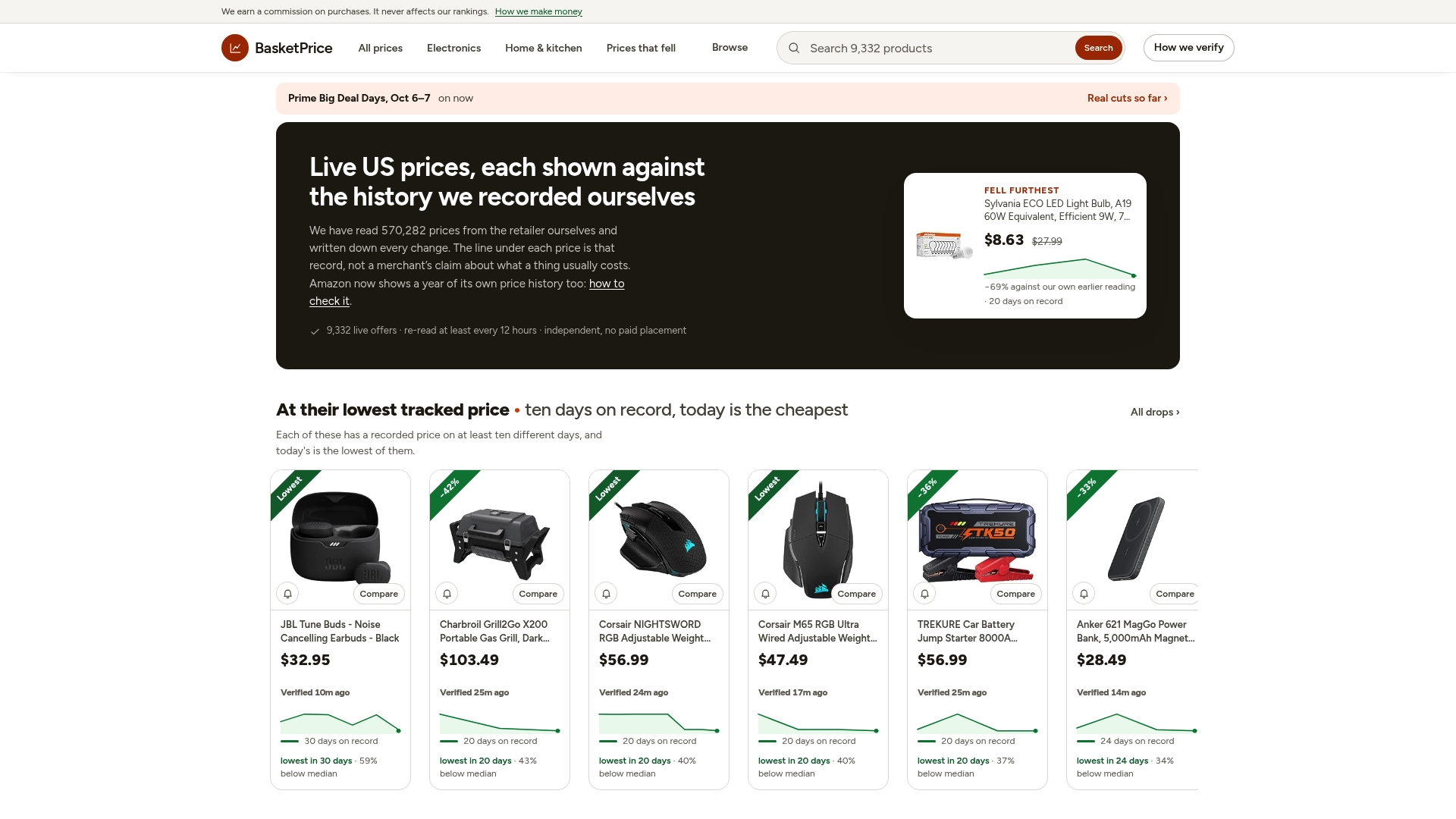
BasketPrice tracks Amazon prices against their own recorded history. You can follow specific items, see live offers and get an alert when a price drops, so you can compare the delivered total when the price is actually low. Start with our Amazon price tracker, or browse today's tracked prices against their own history.
BasketPrice earns a commission when you buy through our links, which is how we keep the tracking free to use. Our price records do not depend on what a merchant says, they depend on what we recorded.
FAQ
Is free shipping worth it?
It is worth it when the delivered total is lower, or when the item you add to qualify is something you would buy anyway. It is not worth it if the item price was raised to cover delivery, or if you add something you do not need. Compare the final checkout totals to find out.
Is free shipping really free?
Usually the cost is built in somewhere. A 2013 academic study found that stores which charge for shipping set lower product prices but higher total prices than stores with free shipping. So the shipping charge is not always the extra cost: the other store's item price may simply be higher. The total at checkout is the only fair comparison.
Should I add an item to reach a free-shipping minimum?
Only if the added item costs less than the shipping you would otherwise pay, and you would use it. A $7 item to avoid $10 shipping saves you $3. A $9 item to avoid $6 of shipping costs you $3 more. Also check whether the minimum counts before or after coupons.
How do I compare two stores quickly?
Put the same item in each cart, choose the same delivery speed, enter your ZIP code and read the final total. Apply only coupons that are valid for you. Then check the item's price history to see whether the lowest total is also a good price.
Sources
- Compare Shipping Costs and Delivered Prices Online
- When free shipping disappears: how to beat delivery fees without overpaying (ConsumerAffairs)
- How to Calculate the Real Final Price of Anything You Buy
- Total Cost Comparison Shopping Guide
- How the Offer of Free Shipping Affects On-line Shopping (Knowledge at Wharton)
- Free Shipping or Dollar Off? The Moderating Effects of Product Price and Experience
- 2026 Data: Ecommerce Conversion Optimization Drivers (Bizrate Insights)
- 2024 Holiday Insights & Trends (SurveyMonkey)
- Shipping Fees or Shipping Free? A Tale of Two Price Strategies
- What's the real cost of free shipping for brands (Thingtesting)
- Does free shipping really exist? (The Conversation)
- Influence of Free Shipping on Consumer Cart Conversion (GJRBM)
- Is Free Shipping Worth It? A Simple Way to Decide
- Does Shipping Speed Really Matter When Buying Golf Clubs?