

Neither day wins across the board. Black Friday (November 27, 2026) tends to be stronger for big-ticket items like TVs, appliances and mattresses. Cyber Monday (November 30, 2026) tends to be stronger for smaller electronics, laptops, fashion and household basics. In practice, the sales now blur together, and the lowest price on a given product often shows up days before either date. So the smartest move is to pick the products you want now and watch their real price history.
Below you will find how the two days differ, what to buy on which, how Amazon's own events fit in, and a simple way to tell a genuine discount from a painted-on one.
TL;DR
- Black Friday is the day after Thanksgiving and runs online and in stores. Cyber Monday is the Monday after and is built around online shopping.
- Large electronics, appliances, mattresses and furniture lean Black Friday. Smaller electronics, laptops, apparel and household essentials lean Cyber Monday.
- On Amazon, one 2023 analysis found fewer deals and slightly shallower discounts on Cyber Monday than on Black Friday.
- Prime Day and Prime Big Deal Days are Amazon's own events, and many products hit their lowest price in the days before them.
- Set a price alert now and compare any "sale" price against the real 90-day and 365-day lows.
Table of Contents
- Black Friday vs. Cyber Monday at a glance
- When each one falls in 2026
- Is Cyber Monday really online-only?
- Which day has better deals, by category
- What the data says about Amazon
- Prime Day vs. Black Friday vs. Cyber Monday
- How to tell if a Black Friday deal is real
- Our perspective
- Start tracking before the sales begin
- A simple plan for the long weekend
- FAQ
- Sources
Black Friday vs. Cyber Monday at a glance
The two events started in different places. Black Friday began as an in-store event, while Cyber Monday was coined by the National Retail Federation in 2005 as an online-focused alternative. That origin story still shapes how people talk about them, even though the shopping reality has moved on.
| Black Friday | Cyber Monday | |
|---|---|---|
| 2026 date | Friday, November 27 | Monday, November 30 |
| Where deals appear | Online and in stores | Online, with some stores matching |
| Strongest categories | Large electronics, appliances, mattresses, furniture, smart-home devices, home goods | Smaller electronics, laptops, beauty, fashion, household essentials, subscriptions, software |
| Best for | Big purchases you can plan around | Smaller items and online-only offers |
| Typical risk | Doorbuster stock sells out fast | Fewer deals on some retailers' sites, and lots of repeats from Black Friday |
The category split comes from NBC Select's comparison of the two events. Treat it as a tendency, not a rule. Every retailer sets its own calendar.
When each one falls in 2026
Black Friday is always the day after U.S. Thanksgiving, which is the fourth Thursday of November. This year Thanksgiving lands on November 26, so Black Friday is November 27. Cyber Monday is the Monday after Thanksgiving, which makes it November 30, 2026.
That is the calendar. The sales calendar is looser. Retailers now start early, and many run promotions for a week or more. We track the pattern each year on our own pages for Amazon's Black Friday window and Cyber Monday versus Black Friday, so you can see what the current season looks like.
Is Cyber Monday really online-only?
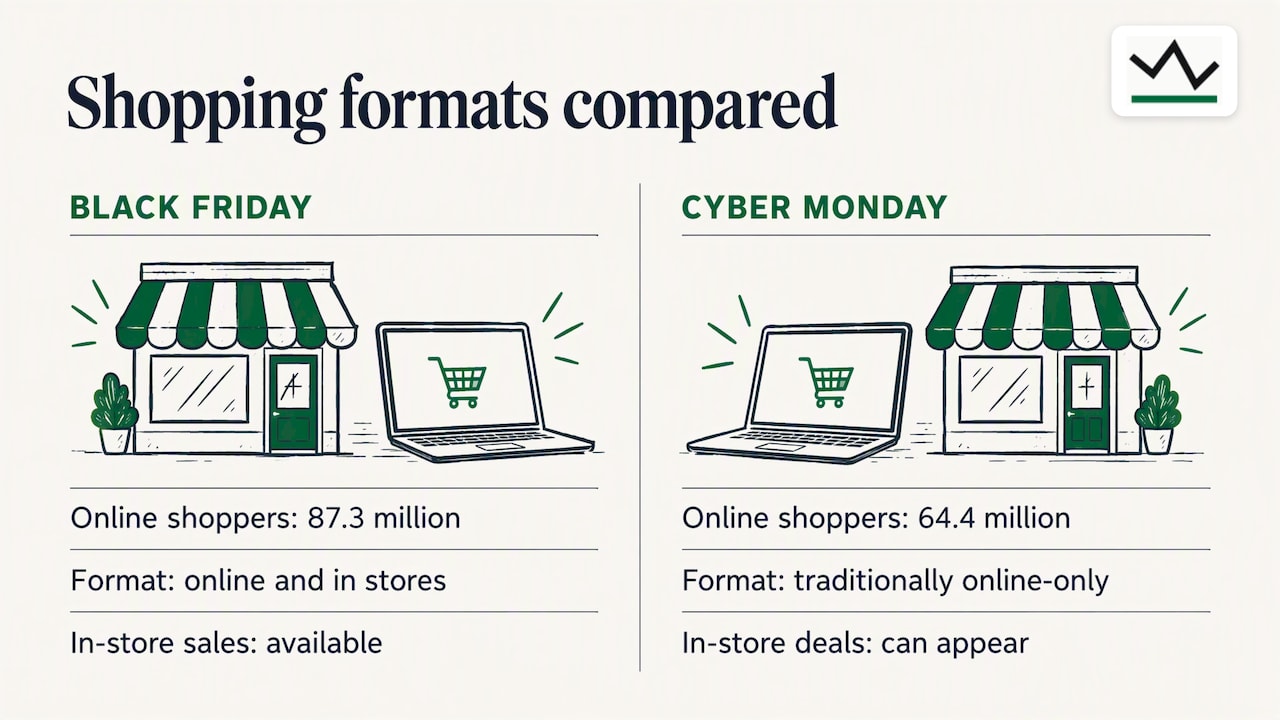
Mostly yes, with exceptions. Black Friday sales are available online and in stores, while Cyber Monday is online-only in the traditional definition. In practice, Cyber Monday deals can also appear in brick-and-mortar stores, so the label is not a hard boundary.
The older split has also faded for a bigger reason. NBC Select notes that retailers now run multi-week promotions and e-commerce dominates both events. The question is less "online or in store" and more "which format suits this purchase."
Online helps when you want to compare prices quickly. In stores, you may find location-exclusive deals, gifts, immediate possession and buy-online-pick-up-in-store options. If you need a gift in your hands the same day, or the item is heavy and awkward to ship, the store version of Black Friday can be the better fit.
The crowd numbers show where people actually go. NerdWallet reports that 87.3 million people shopped online on Black Friday 2024 versus 64.4 million on Cyber Monday. Black Friday is the bigger online day too.
Which day has better deals, by category
Here is a practical way to use the split. Match the product to the day, then confirm the price.
Buy on or before Black Friday
- TVs and large electronics. Doorbuster pricing is typically aimed at these, and they are the items retailers use to pull people in.
- Large appliances, mattresses and furniture. These are the big-ticket home categories NBC Select associates with Black Friday.
- Smart-home devices and home goods. Cameras, plugs, speakers and displays are frequent Black Friday markdowns. Our smart home price tracker shows what these devices typically cost right now, so you know what a good price looks like.
- Consoles and headphones. These are frequent targets for early and Black Friday pricing.
Buy on or after Cyber Monday
- Laptops and smaller electronics. Accessories, tablets and computer gear are common Cyber Monday picks.
- Apparel, beauty and household essentials. If you are shopping for clothes or restocking basics, Cyber Monday tends to be the day.
- Subscriptions and software. Digital offers are a natural fit for an online-only event.
- Kitchen gadgets. NerdWallet says Cyber Monday tends to have better deals in categories such as kitchen gadgets.
If you are mostly shopping for gear and gadgets, our electronics price page shows typical prices of $79 to $650 in October 2026. Our sports and outdoors page shows typical prices of $22 to $120. Those ranges help you judge whether a headline discount is a real bargain or just the normal price with a banner on it.
Smaller online shops join in too. If you are shopping for tech and accessories outside the big marketplaces, check in-stock electronics deals that ship quickly, since stock and delivery times matter more as the holidays near.
What the data says about Amazon
Amazon is where most of our readers shop, so it deserves its own look. Yes, Amazon does Cyber Monday. The more useful question is whether it matches Black Friday.
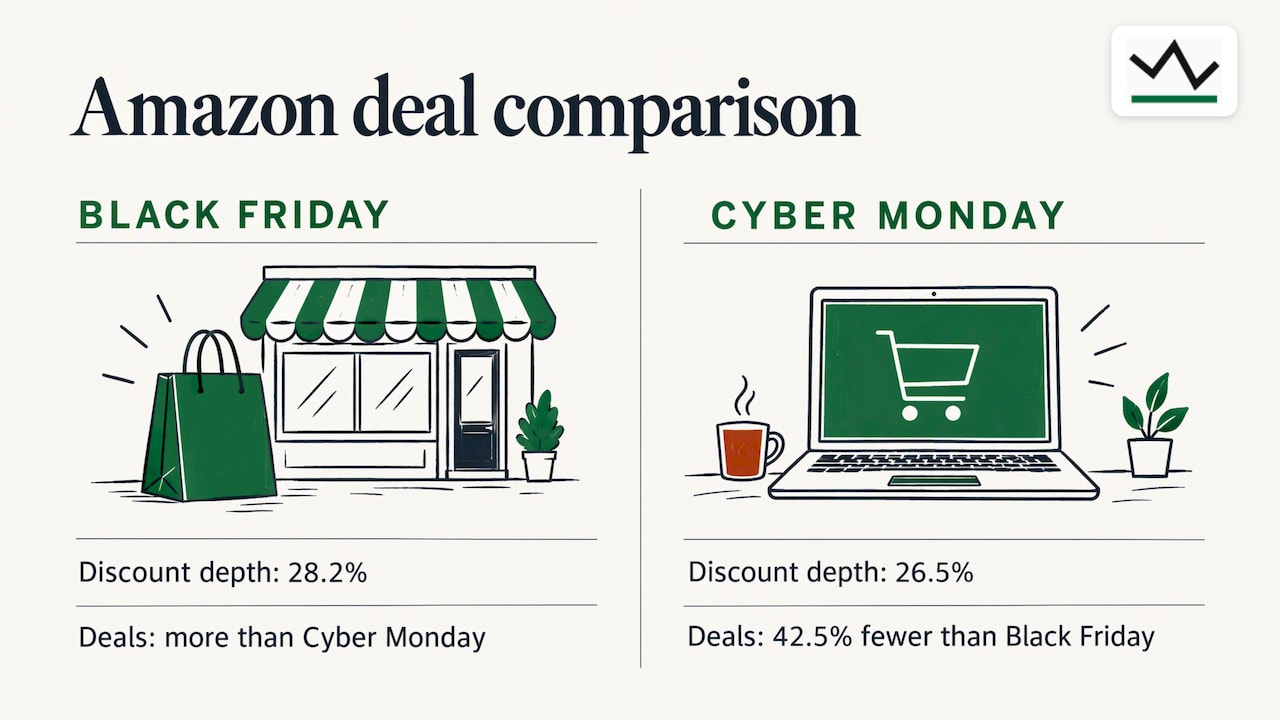
An analysis of Amazon's 2023 results measured both days. Average discount depth fell from 28.2% on Black Friday to 26.5% on Cyber Monday. Amazon also had 42.5% fewer deals on Cyber Monday than on Black Friday. That is one year and one retailer, so do not treat it as a law. It does match the pattern many shoppers report: on Amazon, Black Friday is often as good as Cyber Monday or better.
The bigger finding is about timing. In Amazon's 2023 weeklong event, average discounts were 13% on the day before Black Friday and 13% on the day before Cyber Monday, versus 5% and 3% on the named holidays. In other words, the days before the headline dates can be where the savings are. Waiting for the exact day can cost you.
Prime Day vs. Black Friday vs. Cyber Monday
Amazon runs its own sales on top of the shared shopping calendar. Prime Day is a summer event for Prime members, and Prime Big Deal Days is the fall version. This year Prime Big Deal Days ran October 6 to 7, 2026, and it kicked off the holiday season. These events are open to Prime members only, while Black Friday and Cyber Monday are open to everyone and spread across many retailers.
| Prime Day / Prime Big Deal Days | Black Friday | Cyber Monday | |
|---|---|---|---|
| Who runs it | Amazon | Retailers everywhere | Retailers, mostly online |
| Who can shop | Prime members | Anyone | Anyone |
| Length | A couple of days | A day, often a week or more of promotions | A day, often part of a longer run |
| Best for | Amazon-owned devices and household basics | TVs, appliances, headphones, consoles | Laptops, small electronics, fashion |
Which is better? For Amazon-owned devices, Prime events are usually the sensible time to look. For a TV or an appliance, Black Friday is the stronger bet. For a laptop or a clothing haul, Cyber Monday is worth waiting for.
There is a catch with Prime events too. Across 13 Amazon categories in its 2024 Prime Day analysis, only five had their lowest average sale prices during Prime Day. Most reached their lowest prices in the preceding days. We looked at what happened in the most recent event on our Prime Big Deal Days page, and it is a good reminder to check the history before you click buy.
How to tell if a Black Friday deal is real
The advertised discount is measured against a "was" price. That reference price is set by the merchant, and it can be inflated. The fix is to compare against what the item really sold for. Here is the routine we recommend.
- Look up the price history. Check the 90-day and 365-day lows. Our guide to checking price history before you buy walks through what to read in those charts.
- Compare today's price to the lows. If the sale price equals the 365-day low, it is a strong deal. If it is higher than the 90-day low, you may do better by waiting.
- Ignore the "was" price. Judge the deal by the lowest recent price, not by the strikethrough. Our walkthrough on how to track Amazon prices and verify the was price covers the details.
- Set an alert. Alerts catch drops while you do other things. Our guide to Amazon price alerts explains how to confirm a drop against up to a year of data.
- Buy when it hits your number. Decide your target price before the sales start, so a countdown timer cannot decide for you.
For store-specific research, we also have guides to seeing Amazon price history and Best Buy price history. If you want to see products whose prices really fell, our Amazon discount finder lists them.
A worked example
Suppose you want a monitor. The banner says 30% off on Black Friday. You pull up the history and see that the same monitor sold for nearly that price twice in the past year, once in spring and once the week before Thanksgiving. The 30% off is real, but it is not rare. If the price you see on the day is higher than the previous low, you can wait, or you can buy knowing you are paying a bit extra for convenience. Our month-by-month monitor guide shows how seasonal timing plays out for that category.
The point is that you now have a number, not a feeling.
Our perspective
Every year the same debate returns: which day is better? We think it is the wrong question. The right question is which price is real, and that is something you can check.
The headline discount on a deal page is usually a comparison to a reference price the merchant chose. We prefer to publish price records based on our own collected price history, not on merchant claims. That makes a sale price easy to judge: is it lower than what the product actually cost in the past 90 days, or the past year?
We also see that the best price often arrives before the named event, and sometimes after it. That is why our alerts do not just fire on a drop. They can also catch a price drop after you buy, inside a return window, so you are not stuck with a worse deal. And our browser notifications work with no sign-up, so you can start watching a product in seconds.
Our advice is simple. Pick the five or six things you actually want, watch them from now, and let the price history tell you when a deal is worth taking. The calendar is just the backdrop.
Cleaning
Start tracking before the sales begin
The best time to prepare for Black Friday and Cyber Monday is before they start. BasketPrice tracks prices on Amazon products, records its own price history, and sends alerts when a price drops or an item comes back in stock. You can browse by category, including electronics, home, car and sports and outdoors, on our home page, and pick the items you want to watch.
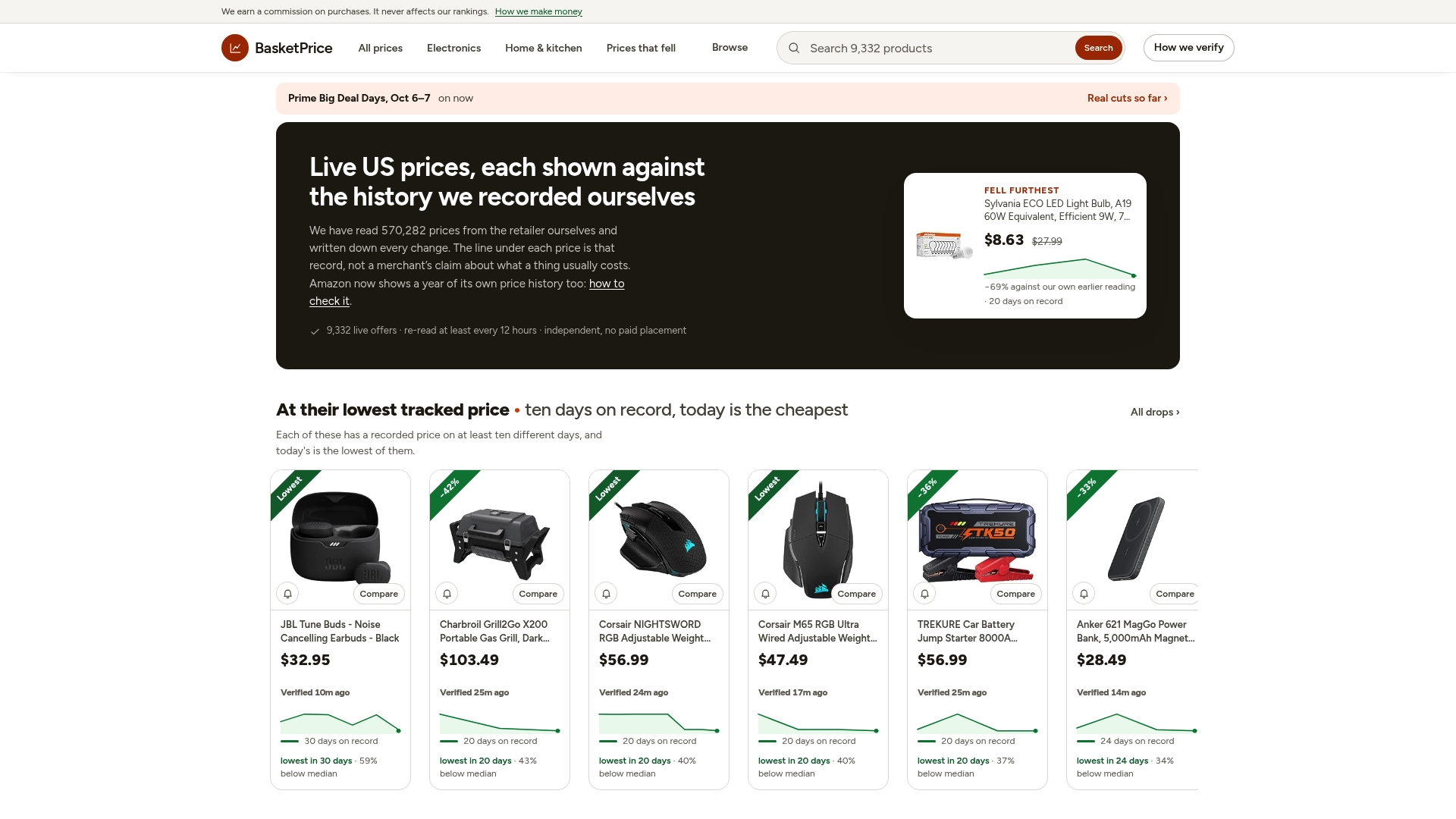
If gear is your focus, start with our best-selling electronics or our best time to buy sports and outdoor gear page. If you are shopping for the car, car electronics prices are tracked too.
A simple plan for the long weekend
A short plan beats a long list of tabs.
- Now through mid-November: build a short list of products and set alerts. Note the 90-day and 365-day lows for each one.
- The week before Black Friday: watch for early drops. Many of the lowest prices appear here, not on the day itself.
- Black Friday: buy big-ticket items if they hit your target price. Stock on doorbusters goes fast.
- Weekend: let prices settle. Some deals repeat or improve.
- Cyber Monday: buy laptops, small electronics, apparel and household basics if the price is at or near the low.
- After you buy: keep an eye on the price during the return window. If it drops, you may be able to claim an adjustment or return and rebuy, depending on the store's policy.
Each year the exact dates of retailer promotions change. Check the retailer's own page for the current schedule rather than relying on last year's.
FAQ
Is Black Friday or Cyber Monday better?
It depends on what you are buying. Black Friday tends to be better for large electronics, appliances, mattresses and furniture. Cyber Monday tends to be better for smaller electronics, laptops, fashion and household essentials. On Amazon in particular, Black Friday has often been equal or stronger, so do not wait for Monday by default.
Does Amazon have Cyber Monday deals?
Yes. Amazon participates in Cyber Monday promotions. In a 2023 comparison, Amazon had fewer deals and a slightly lower average discount depth on Cyber Monday than on Black Friday. Its deals are usually spread across the whole week, so check the days before as well.
Which is better, Prime Day or Black Friday?
Prime Day suits Amazon-owned devices and household basics, and it is limited to Prime members. Black Friday suits TVs, large appliances, headphones and consoles, and it spans many retailers. Many products reach their lowest price before Prime Day itself, so check the price history either way.
Is Cyber Monday only online?
Cyber Monday was created as an online event, and it still centers on online promotions. Some brick-and-mortar stores run Cyber Monday deals too. Black Friday, by contrast, has always included both in-store and online sales.
Sources
- NBC Select: Black Friday vs. Cyber Monday Deals
- NBC Select: Black Friday shopping guide
- Shopify: What Is Cyber Monday?
- Newsweek: Is Cyber Monday an only online event?
- NerdWallet: When is Cyber Monday?
- Engage3: How did Amazon change its approach to Cyber Monday vs. Black Friday
- Jungle Scout: Amazon's biggest sales events report
- Amazon: Prime Big Deal Days October 6-7, 2026